PAID, Owned, Earned and Shared Media: Understanding the PESO Model
If your website traffic has quietly fallen off and you can’t work out what you did wrong, you probably didn't do anything wrong. Google organic search traffic to more than 2,500 sites dropped 33% globally between November 2024 and November 2025, according to analytics data reported in the Reuters Institute’s Digital News Report 2026. Same content. Same site. A third fewer people find it.
That is what happens when a business leans its whole visibility on one channel and the channel changes underneath it. So before anything else, it’s worth knowing exactly how many channels you have.
Paid media is attention you buy. Owned media is attention you’ve created yourself. Earned media is attention somebody independently decided you deserved. Shared media is attention that travels through word of mouth.
That is the whole vocabulary. Four words. And a surprising amount of wasted budget comes down to mixing them up.
Those four categories make up the PESO model. The reason why communications professionals lean on the model is because they each behave differently when something is actually at stake. They cost different things. They move at different speeds. They fail in different ways. And you cannot measure them with the same instrument.
This article will define paid, owned and earned media, including the explanation of why shared media gets a category on its own. By the end of this article, you’ll decide where your next hour and your next dollar should go towards. What this article won’t do — is tell you earned media always wins, or that your business needs all four. For most small businesses, neither of those things are true.
What the PESO model is
PESO stands for paid, earned, shared and owned media. The model was created by Gini Dietrich, founder of Spin Sucks, and introduced in 2014 through her book of the same name. Dietrich later described its evolution in a PRSA session, explaining that the 2020 revision pulled it away from being a list of tactics and toward describing what happens when the four are integrated.
The split underneath the acronym is older than the acronym itself. In December 2009, Forrester analyst Sean Corcoran published a definition of earned, owned and paid media that drew a line most articles have since quietly dropped: there is fully owned media, like your website, and partially owned media, like a social account. Hold on to that distinction. We come back to it later, and it matters more than it sounds.
Now, here’s the part I would underline. The value of PESO is not in the sorting. A framework that only sorts things is a filing cabinet. What makes this one worth your time is that it forces two questions most businesses never ask: how does one channel feed the next, and what happens if the one channel I depend on stops working?
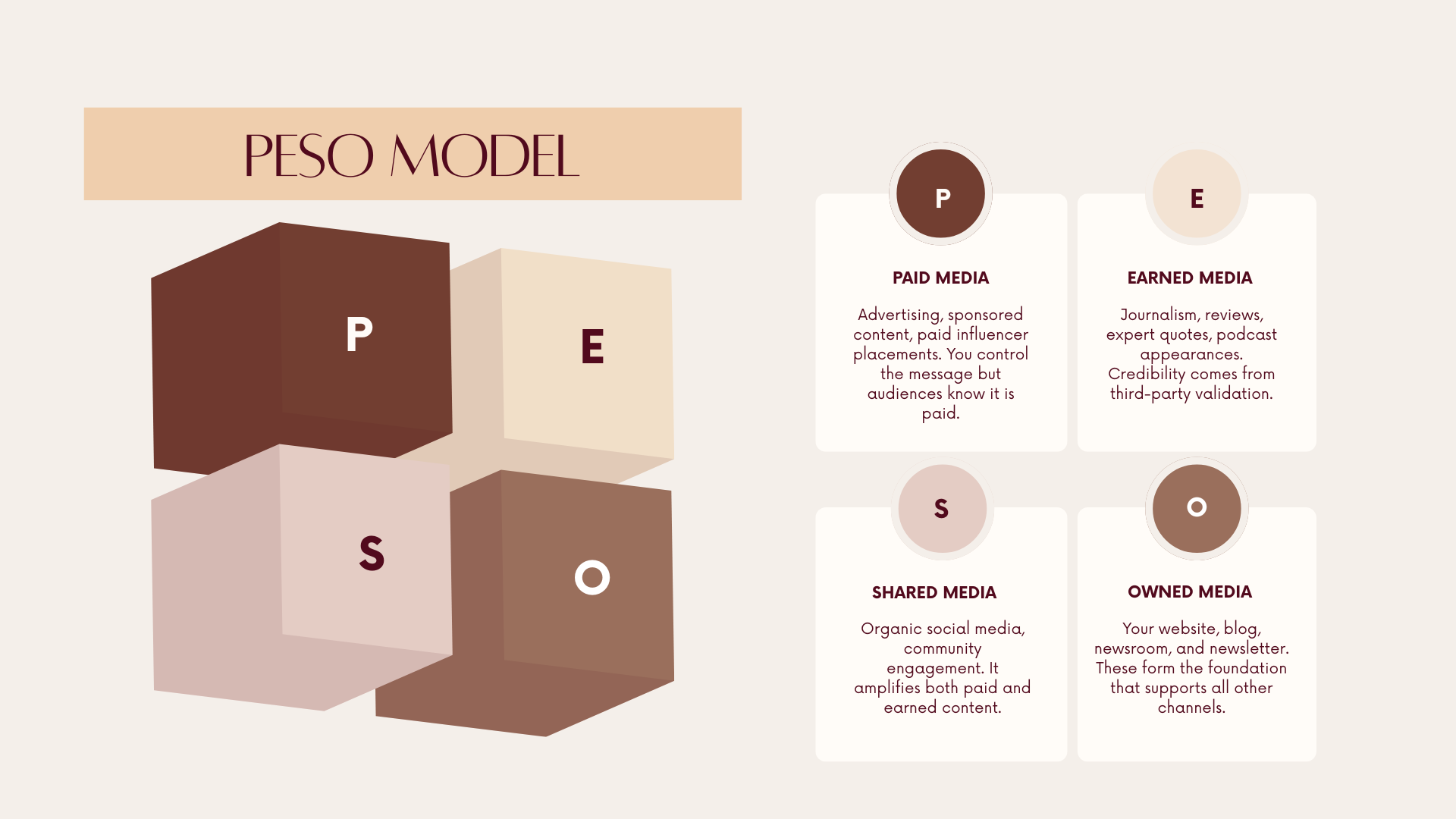
Media relations lives in the earned quadrant. It is the work of building relationships with journalists and editors so that your business is in the room, at least figuratively, when a relevant story is being assigned. If that is new territory for you, our guide to what media relations is and how it works walks through the discipline in full.
Paid, owned and earned media compared with shared media
Before we take them one at a time, here they are side by side.
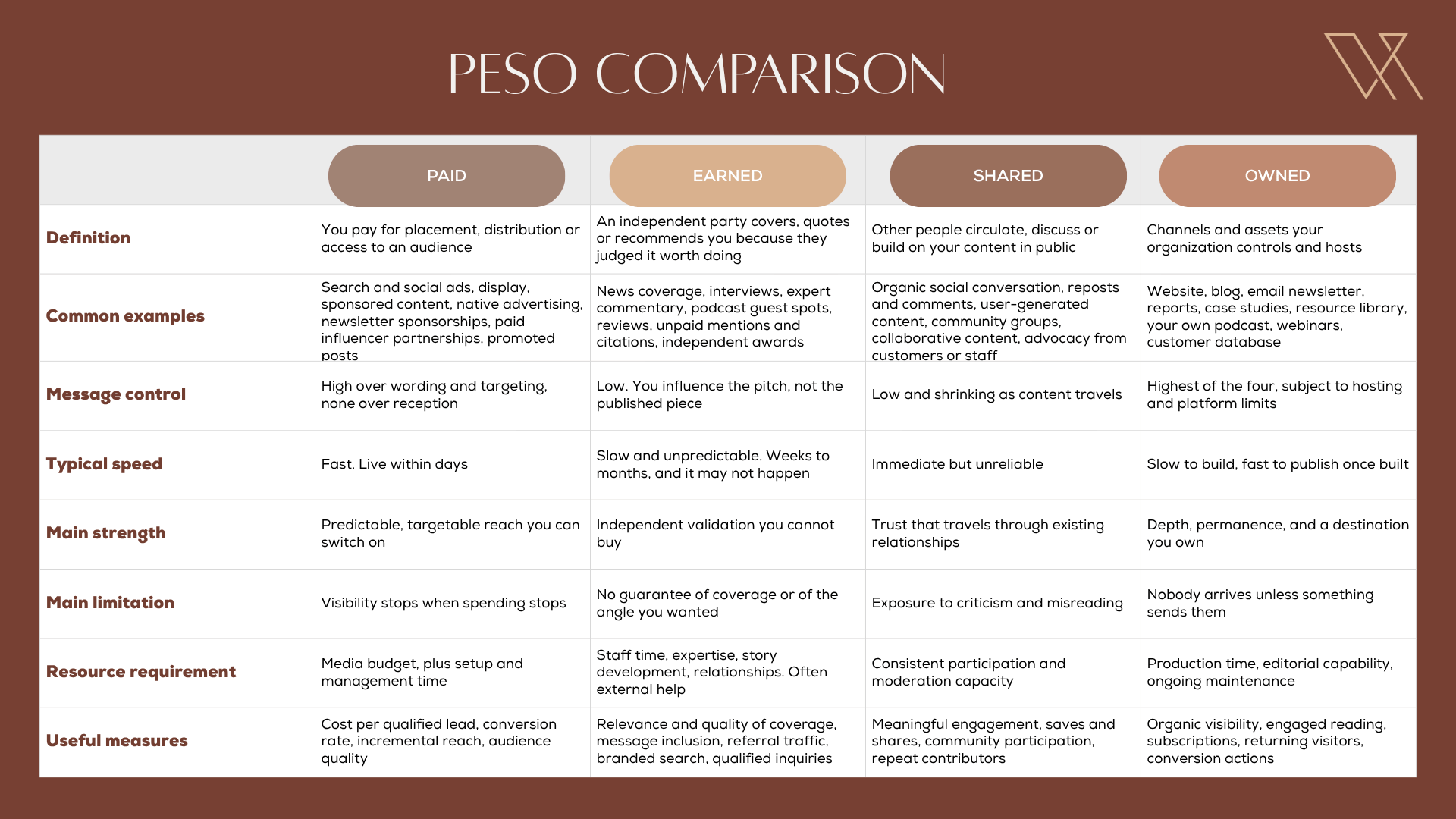
Paid media
Paid media buys you a seat in front of an audience. Search advertising, social advertising, display, native advertising, sponsored content, newsletter sponsorships, paid influencer partnerships. A paid placement in a publication belongs here too, no matter how editorial it looks on the page.
Let me give paid media its due, because people in my line of work tend not to. It is fast. It is targetable. And it is the only one of the four where you decide the wording, the audience and the timing, all three. If you need a specific message in front of a specific group of people by Friday, paid media is the answer. Nothing else on this list can do that.
Now the honest part. Visibility is rented, not bought. The day the budget stops, the reach stops, and nothing is left behind. Audiences also discount advertising precisely because they know somebody paid for it, which is not a flaw in your creative, it’s just how people read ads. Your costs are set by an auction you do not control. And paid media does not create demand that was never there. It finds people. Finding people and persuading them are two different jobs.
One point of confusion is worth settling right here, because it comes up constantly. Sponsored content is paid media. It is not earned coverage, even when it carries a journalist’s byline and sits in the same font as the news. In the United States, the FTC’s Endorsement Guides require a material connection between a brand and an endorser to be disclosed clearly. Search engines draw the same line for their own reasons: Google’s documentation on qualifying outbound links asks publishers to tag paid links with rel="sponsored". Both rules exist for the same underlying reason. The difference between bought and independent is the entire value of independent.
Earned media
Earned media is coverage or attention an independent party chose to give you. A news story. An interview. An expert quote. A podcast appearance. An unpaid mention, a genuine review, an award you did not pay to be considered for.
This is the category my work lives in, which is exactly why I want to be careful not to oversell it.
Its strength is real and it is specific: third-party validation. When a reporter puts you in a story, the implied statement is that somebody with nothing to gain from your success decided you were worth including. That reads differently than an ad. It is why coverage tends to carry weight with the people whose opinion changes your business, including customers, partners, investors and the candidate deciding whether to take your job offer.
Two caveats matter more than most articles will tell you.
First, earned media is not free. You do not pay for the placement, and that distinction is genuinely important. But you pay in staff time, story development, research, relationship building and often outside expertise. The cost moves to a different line of your budget. It does not leave the budget.
Second, credibility is contextual, not automatic. Trust in news itself has been sliding. The Reuters Institute’s Digital News Report 2026, published in June 2026 and built on almost 100,000 interviews across 48 markets, found trust in news at 37% globally, the lowest since it began measuring in 2015, and 25% in the United States. Coverage still moves people. But where it runs and who actually reads it now matter as much as the fact that it ran at all.
And you do not control the output. You control your pitch, your materials, your responsiveness and the accuracy of what you hand over. The newsroom controls the angle, the framing, the length, the headline, and whether the piece runs. Anyone promising you guaranteed coverage is either selling paid placement or is not being straight with you.
The work of earning coverage starts with having something a journalist can justify covering, and that is a narrower category than most business owners expect. Our guide to what makes a story newsworthy lays out the criteria reporters actually apply. From there it runs through media list building, angle development, pitching and follow-up, which we cover step by step in our guide to how to get earned media.
Shared media
Shared media is what happens when other people take part. Organic social conversation, reposts, comments, user-generated content, community groups, collaborative content, and advocacy from your customers or your own team.
It gets its own category because the mechanism is different. Earned media moves through gatekeepers who decide what gets published. Shared media moves through participants who decide what to pass along, and who frequently change the message on the way. A customer recommending you inside a Facebook group and a reporter quoting you in a trade publication are both valuable. You influence them differently and you measure them differently.
This category has gotten much harder to ignore. The Digital News Report 2026 found that social media and video networks are now the most widely used source of news globally, reaching 54% of respondents against 51% for news organizations’ own websites and apps. That is the first time the crossover has happened. The same research found trust in news encountered on social media sitting at 22%, well below trust in news overall. High reach. Lower trust. That combination is the reason shared media deserves a plan rather than a default.
The costs here are participation and exposure. Communities need somebody actually present in them, consistently, which is a staffing commitment and not a campaign. And showing up in public means being criticized in public, sometimes over something that has nothing to do with what you posted. Knowing in advance how you think about deciding what actually needs a response is part of the price of operating here.
Owned media
Owned media is everything your business controls and hosts. Your website. Your blog. Your email newsletter. Your reports, case studies, podcast, webinars and customer database.
Control is what defines it. You decide what it says, how it’s structured, who can see it and how long it stays up. Owned media is also the only category that accumulates. An article you published two years ago can still be working for you today. An ad you ran two years ago is gone.
Now, back to that Forrester distinction. A social media profile is not owned media in the way your website is. You do not control the distribution, you do not write the account rules, and you do not decide whether the account continues to exist. Corcoran separated from partially owned media to fully owned media back in 2009, and the gap between the two has only widened since. Treat your platform profiles as space you occupy. Treat your website and your email list as the things you own.
Owned media is not free either, and it has a distribution problem that is getting worse rather than better. That 33% drop in Google organic search traffic is the clearest sign of it, and it’s the reason publishing something good and waiting for people to find it, is a much weaker plan than it was three years ago. Increasingly, owned assets need paid, earned or shared activity to bring anyone to them.
A press release is a clean example of where the boundary sits. The release itself is an owned asset. You write it, you control it, and our guide to writing a press release journalists will actually read covers the format. Any coverage that follows is earned, and no amount of polish on the release guarantees you get it.
How the four types reinforce one another
Here is where the model starts paying for itself, because the most genuinely useful activity crosses categories. A few patterns you’ll recognize once you start looking for them:
An owned research report or original data set becomes the substance of an earned media pitch. Reporters need something to write about, and a business sitting on proprietary information has more to offer than a business with an opinion.
Earned coverage gets circulated through shared channels, which extends its life well past date of publication.
Paid promotion puts the budget behind an owned asset or a piece of coverage that’s already working, instead of trying to manufacture interest from scratch.
Shared media responses provide shared curiosity or confusion from your audience, which tells you what owned content to build next.
An owned landing page catches the interest the other three generate. Without one, attention arrives and then leaves.
Classification depends on how something was made and distributed, not on what it looks like. The same podcast can be owned media if you produce it, earned media if you were invited as a guest, or paid media if you monetarily invested in the interview. A creator’s post can be shared media because they liked your product, or paid media because you compensated them. When you’re unsure, ask two questions: did money change hands for the placement, and who decided it would run?
One more thing, and this is a habit worth breaking. Resist the urge to map PESO onto a marketing funnel with paid at the top and earned at the bottom. Earned coverage regularly produces someone’s first awareness of a business. Paid search regularly catches people at the moment of decision. These channels interact. They do not stand in line.
The Control, Credibility and Reach framework
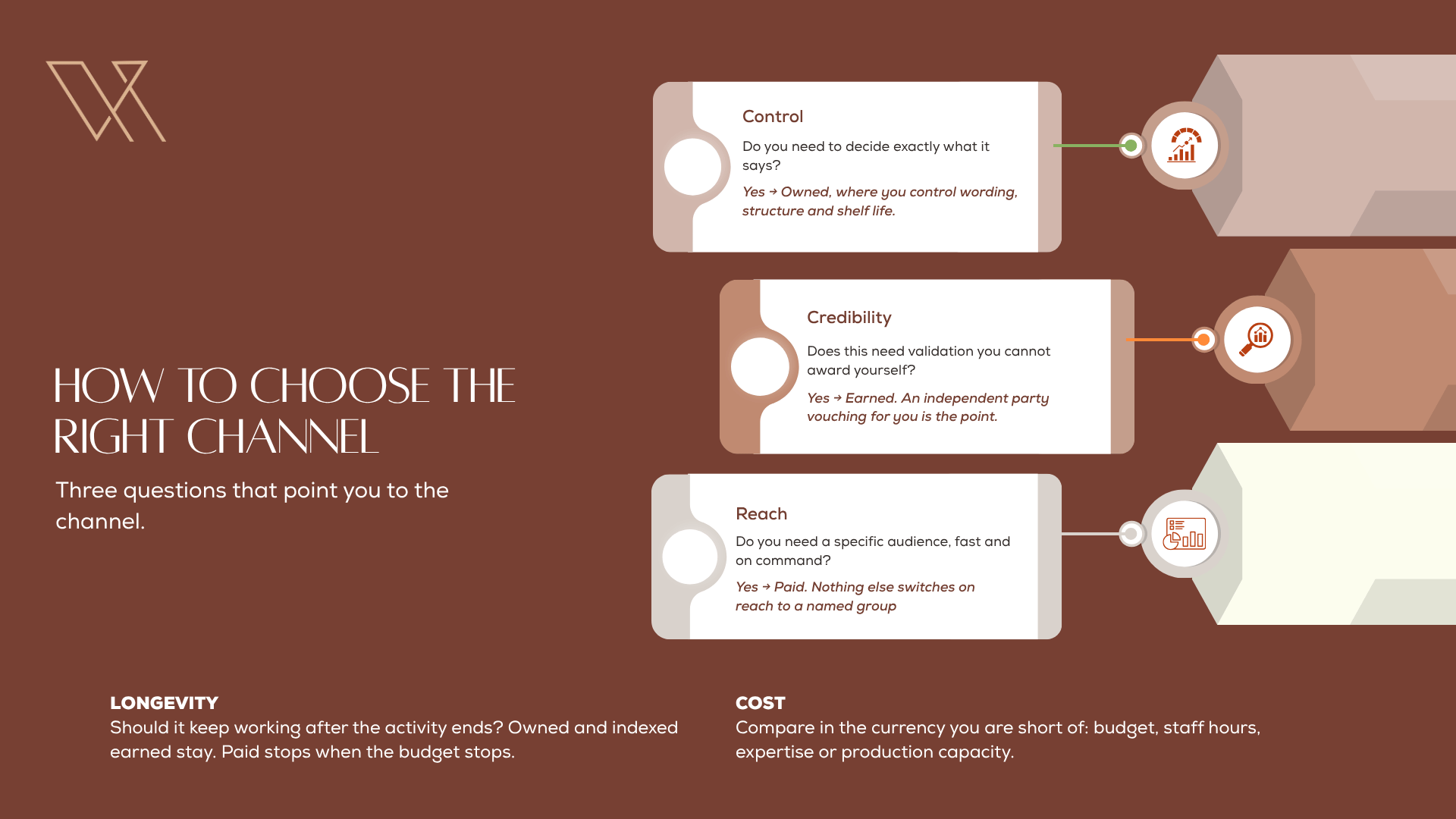
The question is not which media type is best, but which combination fits your current objective. These questions and answers usually settle it:
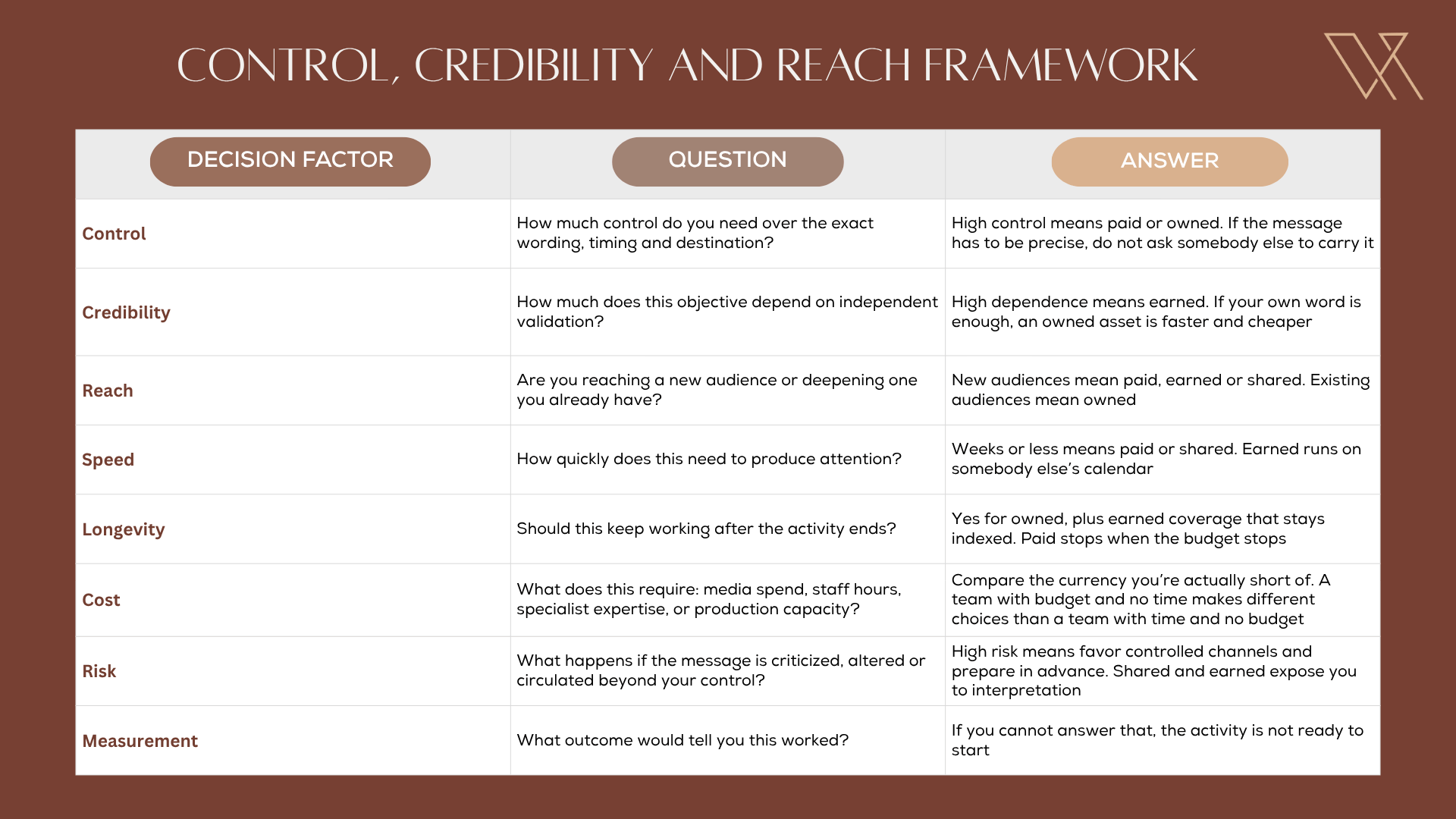
The framework earns its keep when the answers conflict, which they often do. An objective that needs high control, high credibility and speed is asking for something no single channel can deliver. That is not a dead end. It’s your signal to sequence: publish the controlled owned asset now, pursue earned coverage on a longer timeline, and let paid cover the gap in between.
A hypothetical example: one story through the PESO model
This scenario is illustrative. It is not a Vérité House client and contains no real results.
Picture a six-person maternal health technology company in Atlanta. It has a working website, an email list of about 900 people, an Instagram account and no press coverage at all. Over eighteen months of onboarding customers, it has quietly accumulated anonymized data showing how long its users wait between a first symptom and a first clinical appointment.
Objective: be treated as a credible source on maternal health access in Georgia, so that hospital decision-makers who have never heard of the company start to recognize the name.
Audience: health system partnership leads, and the local health reporters those leads follow..
Why these channels: partnership decisions turn on institutional credibility. That is a credibility problem, not a reach problem, and the distinction changes everything. Advertising can put the company’s name in front of the right job titles, but it cannot make an unknown vendor look established. Earned coverage can. Owned media has to be in the mix because a reporter and a partnership lead will both go looking for somewhere to verify the claim.
How it could move through the model:
Owned. The company writes up its wait-time findings as a short, scholarly, honest report and publishes it on its own site with a plain summary page. This is the asset everything else points at.
Earned. It pitches health reporters covering maternal care in Georgia, leading with the finding rather than the company. Our guide to writing a media pitch that gets a response covers how to build that pitch.
Shared. The report, and any coverage it produces, goes into the professional communities where maternal health clinicians and administrators already talk, with the founder taking part in the conversation rather than posting and disappearing.
Paid. A small, tightly targeted budget puts the report in front of health system job titles on LinkedIn, but only after there is evidence that people find the report interesting.
Owned again. Everything routes back to one page, which offers the full report by email.
Resources required: roughly two to three weeks of analysis and writing, a founder who is genuinely available for interviews on a reporter’s schedule, a few hundred dollars of targeted spend, and either internal capacity for media outreach or outside help.
What the company controls: the quality and honesty of the report, the pitch, the responsiveness, the landing page, the ad targeting.
What it cannot guarantee: that any reporter covers it, that the coverage frames the company the way it hoped, that the professional communities engage, or that any of this produces a single partnership conversation.
What it would measure: report downloads and reading depth for owned, whether coverage lands in outlets its target audience actually reads, whether the timing of results align with the newscycle for earned, whether clinicians and administrators engage rather than industry peers for shared, cost per qualified download for paid and over a longer horizon, inbound inquiries from health systems.
Choosing a realistic media mix
A balanced mix does not mean equal investment. It means each channel is doing something the others cannot, and none of them is carrying weight it was never built to carry.
For most small businesses, a workable sequence looks like this.
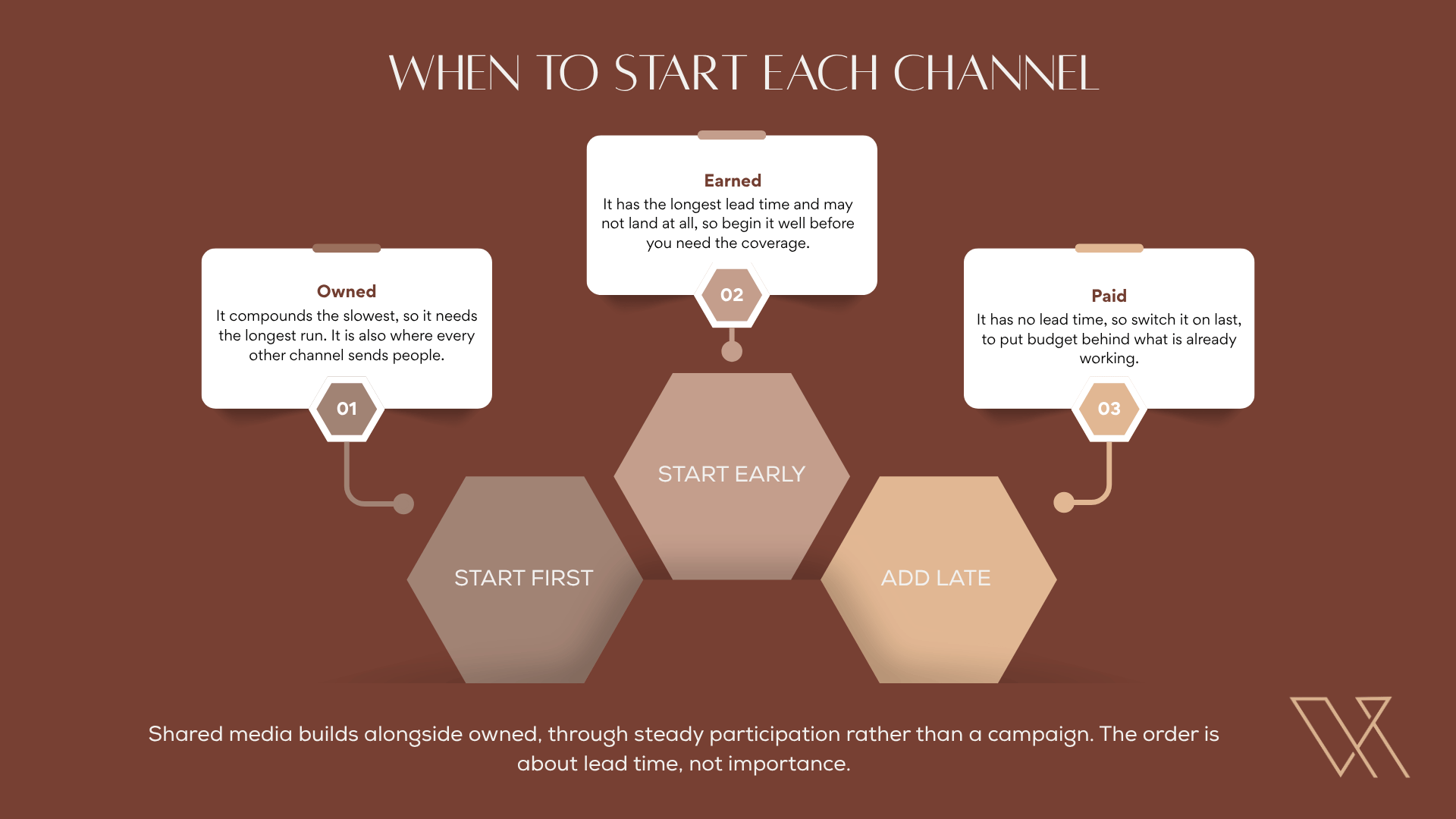
Start with one owned asset that can carry a claim. Not a blog schedule. One thing worth citing: a report, a genuinely useful guide, a set of data, a real case study. Without it, earned and paid activity has nowhere to send people and shared activity has nothing to circulate.
Add the channel your objective actually requires. Run it through the framework above. Credibility problems point to earned. Speed and precision points to paid. Relationship depth points to shared.
Leave one out on purpose. Deciding not to do something is a strategy decision, not a failure of nerves. A firm whose customers all arrive by referral might reasonably run owned and shared media well and skip paid entirely for a year. A company launching against a fixed deadline may need paid and owned first, with earned pursued in parallel on a longer clock.
Do not run all four badly. Four channels operated thinly by one person produces four weak signals and nothing you can learn from. Two channels operated well will teach you something.
Sequencing matters for cost, too. Earned media has a long lead time, so it should be started before you need it. Paid media has no lead time, so it can be added late. Owned media takes the longest to compound, so it should be started first. That logic sits underneath our media relations strategies for small businesses which covers execution in more detail.
How to measure PESO activity
Measurement is where most media strategies quietly fall apart, and the reason is not complicated. The easiest numbers to collect are the ones that mean the least.
The standard worth working from is AMEC’s Barcelona Principles V4.0, published in June 2025. Two of its principles apply directly to your situation. Principle 5 states that invalid measures such as advertising value equivalents should not be used, and that the contribution of communication should be evaluated by outcome and impact instead. Principle 6 states that outputs, outtakes, outcomes and impact should be reported together rather than in isolation.
In plain terms:
Outputs are what you produced or secured. Articles published, ads served, posts made, coverage obtained.
Outtakes are what the audience noticed, understood or felt. Whether they read it, whether they remembered the point, whether their view shifted at all.
Outcomes are what changed. Inquiries, applications, partnership conversations, hiring, retention, your reputation with a specific group of people.
Reach, impressions and mention counts are outputs. They confirm the activity happened. They do not tell you it worked. And advertising value equivalency, which prices coverage as though it were ad space you bought, has been rejected by AMEC since 2010. If it shows up in a report somebody hands you, ask why.
How to measure earned media without leaning on those numbers: judge the relevance and quality of each placement against the audience you actually named, check whether your message survived into the published piece, and track referral traffic, branded search activity, qualified inquiries, and the relationships that now exist which did not before. Sentiment analysis has its uses, but read it with care. Automated tools miss irony, industry shorthand and context routinely.
Paid media is the most tractable of the four: cost per click, cost per qualified lead, conversion rate, landing page actions, audience quality, and where you can isolate it, incremental reach.
Owned media: organic visibility, engaged reading or viewing rather than raw pageviews, newsletter subscriptions, downloads, returning visitors, conversion actions, and whether your content shows up in the journeys of people who eventually convert.
Shared media: meaningful engagement rather than vanity counts, shares and saves, community participation, user-generated content, referral traffic, the quality of the responses, and whether the same people keep coming back to contribute.
A starting point for a small team. You do not need attribution software. You need three things. One owned destination that all activity points to, so you can see what arrives. One question per channel that you answer honestly every month. And a note of the outcome you are actually after, written down before you begin. A spreadsheet with monthly referral traffic, branded search volume, newsletter signups and a short list of inquiries and where they came from will outperform most dashboards, for the simple reason that somebody will actually read it.
Common mistakes worth avoiding
Calling earned media free. It costs time and expertise. Budget for it or do not commit to it.
Treating social profiles as owned assets. Build the email list. The platform can change the rules on you overnight.
Presenting sponsored placement as independent coverage. Beyond the disclosure requirements, it spends the one advantage earned media has.
Buying reach to fix a credibility problem. More exposure to an unconvincing message just produces more people who are unconvinced.
Measuring outputs and calling them results. Coverage volume is not reputation.
Starting earned media the week you need it. The lead time is the whole problem. Relationships built during a crisis are not relationships.
Running all four channels thinly. Two done properly beats four done nominally.
Assuming the model guarantees integration. PESO describes what integration looks like. It will not do it for you.
When to handle this internally and when to get help
A good deal of this work is genuinely doable in-house, and I would rather tell you which parts than pretend otherwise.
Owned media is usually the best candidate for internal ownership. Nobody outside your business understands your customers’ questions better than the people answering them all day, and outsourced content tends to read exactly like what it is. Shared media generally works better internally too, because communities respond to people, not to accounts.
Paid media is a skill question more than a knowledge question. Small budgets can be managed in-house after some learning. Larger or more complex ones usually justify a specialist, because the cost of running it badly scales with the spend.
Earned media is the one that most often benefits from outside support, for three plain reasons. It depends on relationships that take years to build. It requires editorial judgment about what’s genuinely newsworthy, which is remarkably hard to apply to your own business. And it needs sustained activity, which is the first thing to slip when a small team gets busy.
Here is the counterargument, because it deserves saying. External support costs money, takes time to become useful, and nobody can guarantee you coverage. If your business does not yet have anything newsworthy happening, help will not conjure it. In that case, spending the same money on the owned asset that makes you worth covering is the better decision, and I would tell you so.
A practical next step
If you do one thing with all of this, do this.
List everything you currently do to reach people and sort it into the four categories. Most businesses find they are heavily weighted toward one, and that at least one category is completely empty.
Pick one objective for the next quarter and name the single outcome that would tell you it worked. Not a number of posts. A change.
Run that objective through the eight framework questions and see where the answers point.
That takes about an hour, and it will tell you more than most audits.
If the answers point toward earned media, or toward connecting work that is currently running in four separate directions, that is the kind of strategy we build at Vérité House. You are welcome to get in touch and talk it through.
Frequently asked questions
Is social media owned, earned, paid or shared media?
All four, depending on what is happening at the time. Your organic posts are closest to owned media, though the platform controls distribution and account access, which makes it partially owned at best. Your ads are paid media. When customers repost, comment or make their own content about you, that is shared media. And when a journalist finds a story through your account and writes about it, the article that results is earned media. The account is not a category. The activity is.
Is influencer marketing paid or earned media?
It depends entirely on whether compensation changed hands. A paid partnership, including one paid in free product or affiliate commission, is paid media, and in the United States that material connection has to be disclosed under the FTC’s Endorsement Guides. A creator who talks about you because they genuinely want to is earned or shared media, depending on whether they operate like a publisher or like a participant in a community. The line is the transaction, not the person.
Is earned media free?
No. You do not pay for the placement, which is the distinction that matters, but you pay in staff time, story development, research, materials and often specialist help. Calling it free is how businesses end up under-resourcing it and then concluding it does not work.
Are customer reviews earned or shared media?
Practitioners genuinely disagree here, and the disagreement is worth understanding. A review left independently on a third-party platform functions as earned media, because somebody with no connection to you assessed you in public. A review that comes out of an active customer community, or that you asked for as part of ongoing engagement, functions as shared media. Classify by mechanism. If you influenced it through relationship and participation, treat it as shared and measure it that way.
Is public relations the same as earned media?
No. Earned media is an outcome. Public relations is a discipline that pursues that outcome alongside others, including reputation management, stakeholder communication and crisis response. Media relations is the part of PR specifically concerned with journalists and coverage. A PR team may also produce owned assets and advise on paid activity, which is one reason the PESO communications model caught on in the profession the way it did.
Does my business need all four parts of the PESO model?
No. PESO is a way of seeing your options, not a checklist to complete. Plenty of small businesses are far better served doing two channels well than four thinly. What the model is genuinely useful for is spotting dependence. If all of your visibility comes from one channel, you are exposed to anything that changes it, whether that is a platform algorithm, a rising ad auction or a quiet news year.
Which media type gives the most control, and which is most credible?
Owned media gives you the most control over wording, timing and permanence, with paid media close behind on message but still bound by platform rules. Earned media typically carries the most weight, because somebody independent chose to give it. That said, credibility is contextual rather than automatic. Trust in news overall has been falling, so where your coverage appears matters as much as the fact that it appeared.