How to Write a Good Press Release That Gets Read
Most press releases never get read. Not because the news is bad, but because the writing gets in the way. Journalists receive hundreds of press releases every week. The ones that earn media coverage are not necessarily from the biggest companies. They are from the businesses that understood what a journalist actually needs, and delivered it cleanly.
Take Polaroid's 2026 "Analog Rebellion" campaign. Facing a world saturated with AI-generated content, the brand issued a press release that did not just announce a camera. It framed the product as a solution to digital exhaustion, positioning itself at the center of a conversation millions of people were already having. The release was picked up by outlets ranging from Vogue to TechCrunch. It drove hundreds of authoritative backlinks, shifted the brand's perception from retro novelty to modern wellness essential, and reached audiences that months of paid advertising had not. One well-crafted document did all of that.
That is the real power of a press release done right. And it is available to any business willing to approach it with the same clarity and intention Polaroid did.
If you are a business owner who has never written a press release before, or you have sent a few and heard nothing back, this guide is for you. Here is exactly how to write a good press release that gives your story the best possible chance of getting picked up.
What Is a Press Release and When Should You Write One?
According to the 2025 Cision State of the Media Report, 72% of journalists still rank the press release as their #1 most useful resource. In an era where AI and social media are flooding the internet with unverified noise, an official press release stands out as a 'beacon of truth' that 86% of reporters still use to spark their next big story.So what exactly is a “press release”? It is a short, factual document you send to media contacts to announce something newsworthy. It is not an advertisement. It is not a blog post. Its job is to give journalists enough information to decide whether to cover your story and enough detail to write that story with minimal back-and-forth.
You should write a press release when you have genuinely newsworthy information to share. Good reasons include: a new product or service launch, a community initiative or partnership, a significant company milestone, a new hire at the leadership level, a response to a crisis, or an event that the public can participate in. If the news is only interesting to you and not to an outside audience, a press release is probably not the right tool.
For small businesses, a press release punches above its weight. Done well, it builds brand awareness, improves your search visibility through quality backlinks, and shapes how the public perceives your business, all from a single well-timed announcement.
The Structure of a Good Press Release
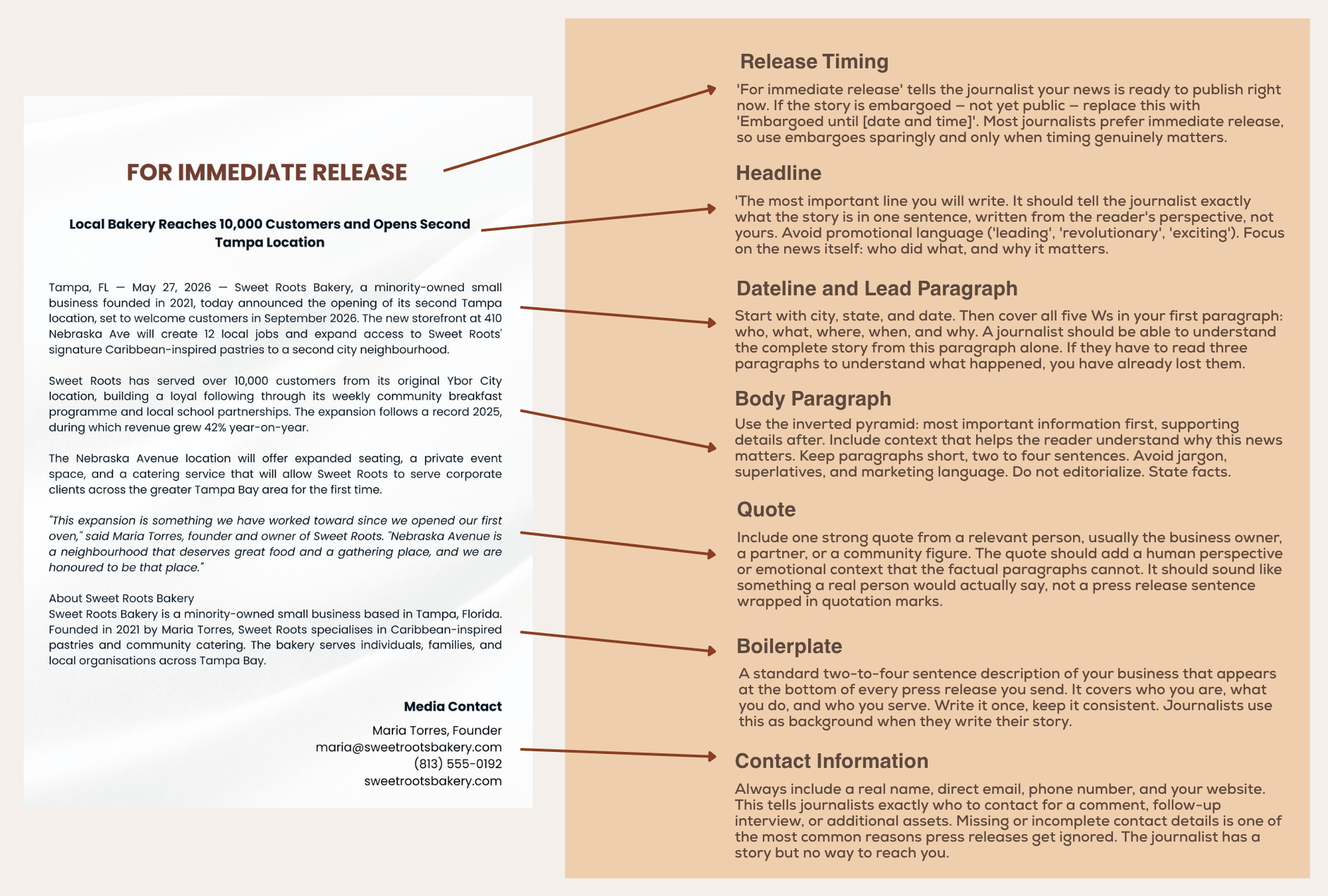
Most press releases follow the same structure, regardless of the type of announcement. Once you know the format, writing a press release becomes much more manageable.
Common Mistakes That Kill a Good Press Release
Writing a press release is straightforward once you know the structure. But a few consistent mistakes tend to undermine even well-intentioned announcements.
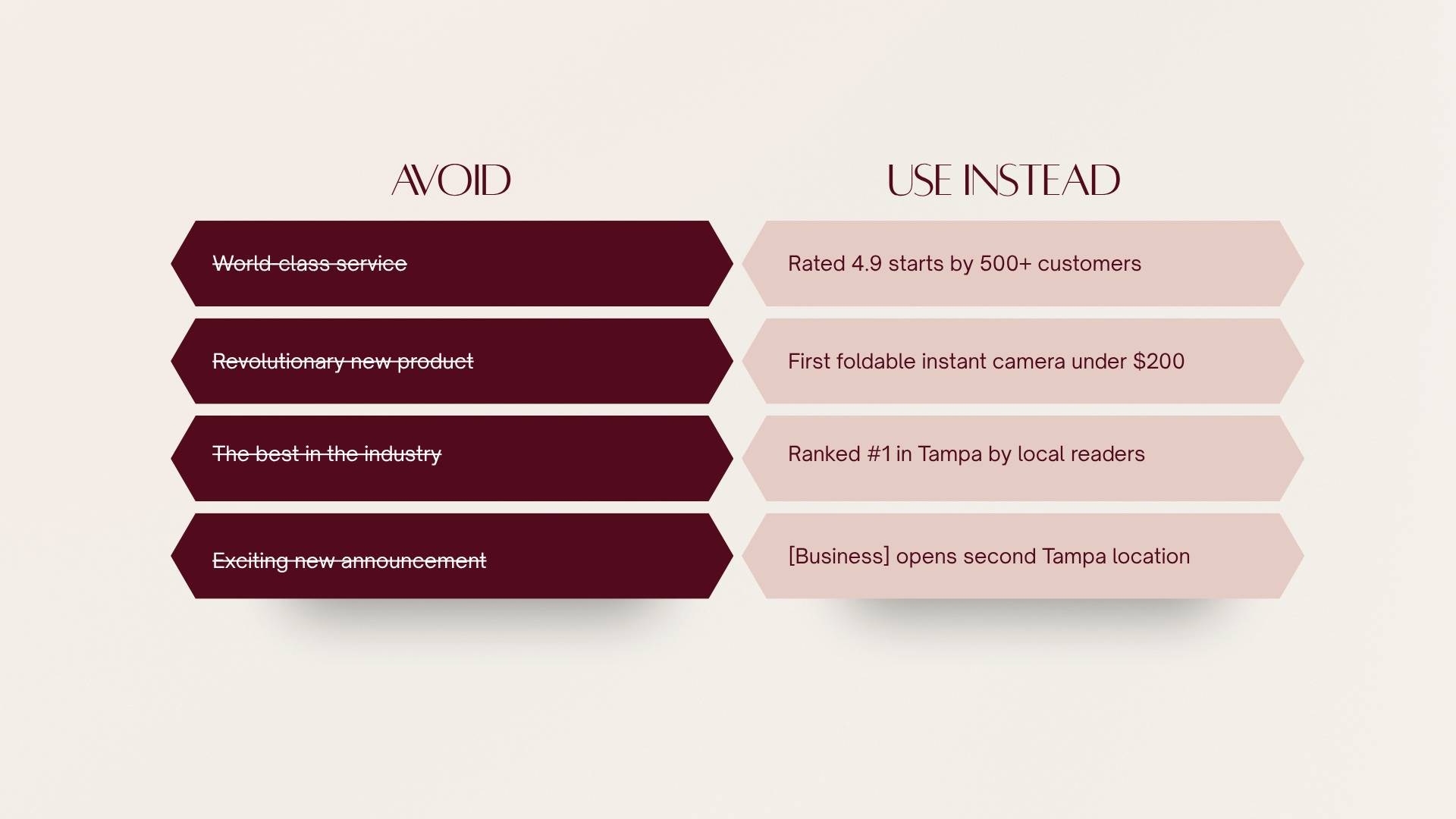
The biggest one is promotional language. Phrases like "world-class," "revolutionary," or "the best in the industry" are red flags for journalists. Unless you have an award or third-party source to back the claim, leave it out. Journalists are looking for information relevant to their readers, not marketing copy.
The second is sending to the wrong people. Not every media outlet covers every type of story. Research your media contacts before you hit send. A press release about a community partnership is relevant to a local digital outlet, but probably not to a national tech publication. Targeting matters.
The third is length. A press release should rarely exceed two pages. Most should be closer to one. Journalists work under tight deadlines. The easier you make it for them to find the information relevant to their story, the more likely they are to use it.
Finally, always proofread before you distribute. Typos signal carelessness, and carelessness signals that you are not a reliable source. Have someone outside your organization read it before it goes out.
How to Distribute Your Press Release Effectively
Writing a press release well is only half the job. Getting it to the right people is the other half.
Start by building a targeted list of media contacts. These are journalists, editors, and producers who cover your industry, your region, or the topic your press release addresses. Local newspapers, trade publications, community newsletters, and radio stations are all worth considering. Research who covers your beat and send directly to them, rather than to a generic inbox.
For wider reach, wire services like PR Newswire or Business Wire can distribute your press release to a large network of media outlets simultaneously. These are especially useful for announcements that have broad regional or national relevance. For most small business announcements, though, a targeted direct pitch will outperform a mass wire distribution.
Timing matters. Send press releases early in the week and early in the day when journalists are actively planning their coverage. Tuesday through Thursday mornings tend to get the best response rates. And always follow up once if you do not hear back within five to seven days. A brief, polite email referencing your original press release is entirely appropriate.
Once the press release goes out, amplify it. Share it on your social media channels. Post it in your email newsletter. Feature it on your website's newsroom page. Media coverage that earns a link back to your site also builds your SEO over time, which compounds the value of every release you send.
A Note on Tone and Authenticity
Your press release is also a statement of presence. It says: we are here, we are doing something worth knowing about, and we want to be part of this conversation. Do not undersell that. Write with confidence.
At the same time, keep the tone professional and factual. The goal of writing a press release is not to promote yourself. It is to give journalists something genuinely useful that they can take and turn into a story. When you do that well, the coverage that follows does the promotion for you, and it does it with far more credibility than any ad ever could.
Your Story Is Worth Telling
Your story deserves to be told — and told well. The press release is just the beginning. If you're a minority business owner ready to step into your visibility with intention and confidence, we'd love to support that journey. Vérité House specializes in helping founders like you craft narratives that don't just get noticed, but get remembered. When you're ready to take your voice to the next level, we're here.