Boiler Plate in a Press Release: What It Is and How to Write One That Holds Up
Here's a quiet truth about most company boilerplates.
Nobody wrote them. Somebody copied them, from the last release, which was copied from the release before that, which was written by a marketing manager who left in 2021.
So let's start with the definition, then get to the part that actually matters.
The boiler plate in a press release format is the short standardized paragraph at the end of your release that explains who your company is. It sits after the news and before, or alongside, your media contact details. It gives a journalist the background information they need to place your announcement in context without opening a browser tab.
Roughly 100 words. One paragraph, sometimes two. Same wording every time, until you deliberately change it.
Where it goes and why the placement matters
The boilerplate in a press release goes at the bottom. Under the final body paragraph, usually labelled "About [Company Name]".
That placement is deliberate. A reporter reads your headline and opening paragraph to decide whether the story is worth their time. Only then do they care who you are. Putting the overview of the company at the top would delay the news, and delay is what gets releases deleted.
The pressure on that reader is real. Cision's 2026 State of the Media Report, based on a survey of 1,899 journalists across 19 markets, found most are sorting through more than 50 pitches a week and consider only a fraction relevant to their audience. Asked what PR people could do to better support their work, journalists' most common answer was to provide clear, accurate, complete information up front.
Your boilerplate is a small part of that answer. It's the bit that lets someone quickly understand what your business is before they decide whether to reply.
What belongs in an effective boilerplate
Five things, in roughly this order.
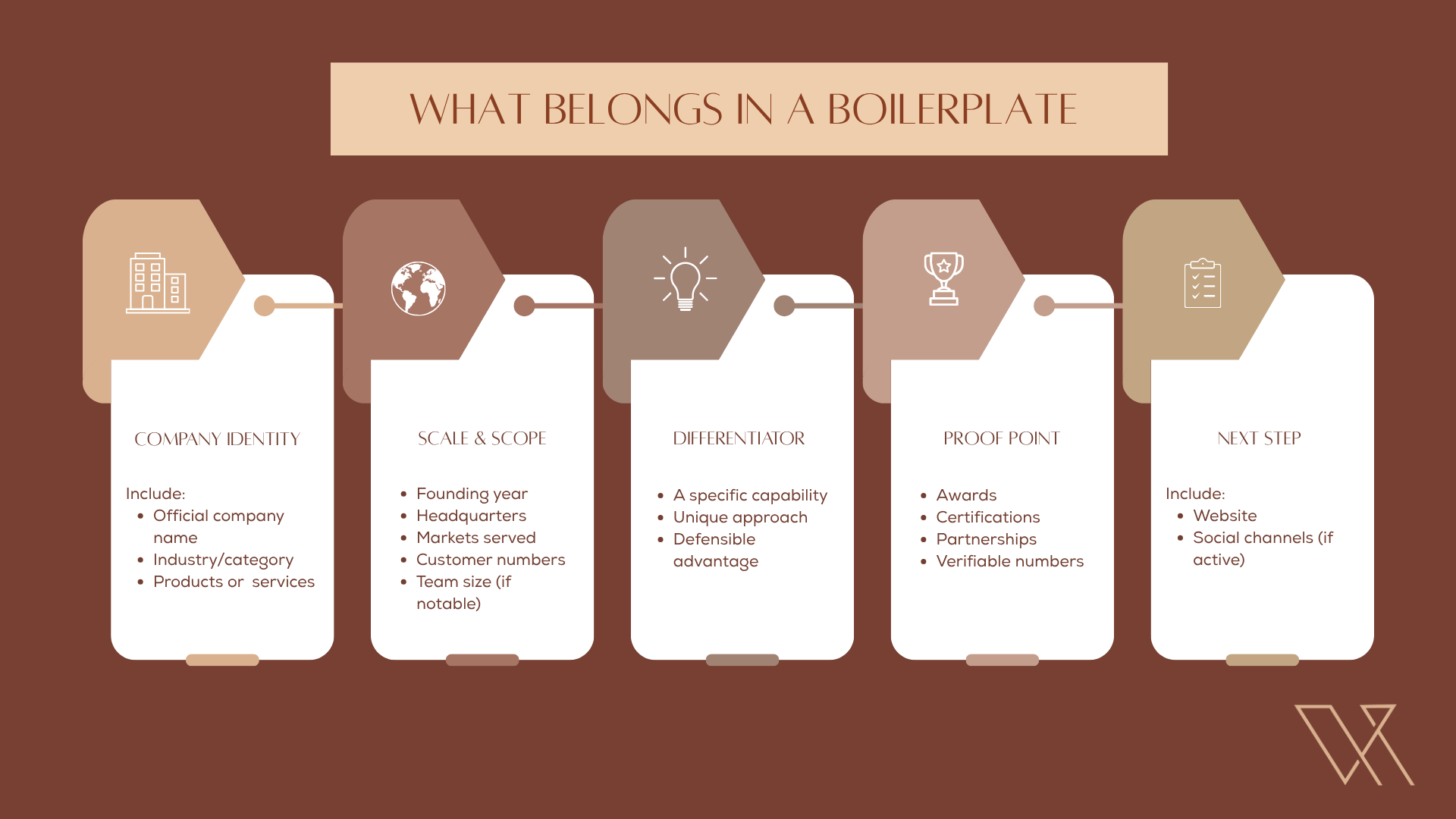
What you are and what you do. Official company name, category, and the products or services you actually sell. Plain language.
Scale or scope. Founding year, headquarters, staff numbers, customer numbers, markets served. Whichever ones are genuinely notable.
One differentiator. The thing that's true of you and not of your three closest competitors.
A proof point. An award, a certification, a named partnership, a verifiable number.
Where to go next. Your website, and social media handles if you're active on them. The convention is a closing line: for more information, please visit [URL].
Two things that don't belong: your mission statement written in the language of a strategy offsite, and any adjective you can't defend. "Leading provider of innovative solutions" tells a journalist nothing and costs you a sentence you could have spent on a fact.
A before-and-after rewrite
This example is invented, but the pattern is one you'll recognize.
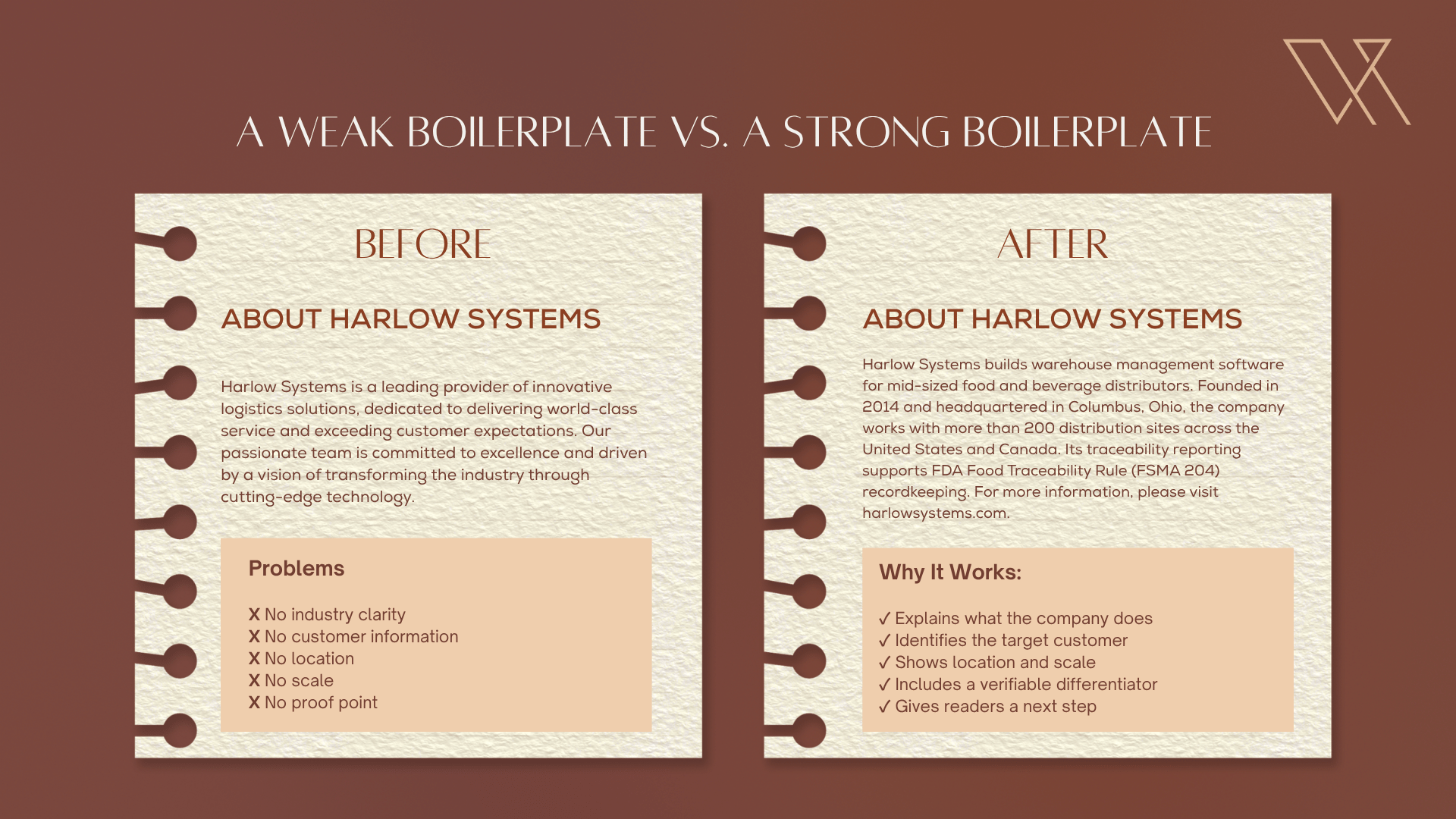
Before:
Forty-one words that could describe roughly 9,000 companies. No sector, no size, no location, no link.
After:
Sixty-two words. A journalist now knows the sector, the customer type, the size, the geography and the regulatory angle. That's what a strong boilerplate does. It answers the questions a reporter would otherwise have to ask you by email.
The audit nobody runs
This is the part people skip, and it's where the real damage happens.
Your boilerplate copy gets pasted into every release you send. Journalists lift it, sometimes close to verbatim, into the "About the company" line at the bottom of published articles. It lands in your media kit, your investor updates, your partner announcements. One paragraph, reproduced hundreds of times, working on your brand recognition in the background over the long term.
Which means when it goes stale, it goes stale everywhere.
Run through these six points once a year, and after any material change in the business:
Headcount and customer numbers. Are the figures still accurate, or are they from the last funding round?
Locations. Offices opened, offices closed, headquarters moved.
The differentiator. Is it still a differentiator, or have four competitors caught up?
Named partners and clients. Do you still have permission to name them? Contracts end.
Links and handles. Dead URLs and abandoned social media accounts are more common than you'd think. Check every one.
Claims. Anything with "largest," "first," or "only" in it needs to still be provable today.
That last one carries real risk, which is worth a moment.
The claims problem
Superlatives in a boilerplate feel harmless. They're marketing and PR copy, not a contract.
But a boilerplate is a published statement about your business, reproduced across wire services and news sites, and in some sectors that puts it in scope for advertising standards and consumer protection rules. Requirements vary by jurisdiction and industry, so this is worth a short conversation with whoever handles your legal or compliance review rather than a decision made in a Google Doc at 5pm.
The practical rule is simple. If you'd struggle to produce evidence for a claim within an hour, take it out. "One of the largest" is defensible with a source. "The best" almost never is.
What to cut when you're over 100 words
You'll draft 160 words and need to lose 60. Here's the order to cut in.
Vision statements go first. Then any adjective doing no work. Then your founding story, unless the date itself is the credential. Then the second and third differentiator, because one strong claim beats three weak ones.
Keep the sector, the customer, the size, and the link. Those four carry almost all of the useful signals.
One version usually isn't enough
Most companies keep exactly one boilerplate. Then they hit a release where it doesn't fit, and improvise something on deadline.
Keep three instead.
A standard version at around 100 words for ordinary announcements. A short version of 30 to 40 words for releases where space is tight, or where the news is short enough that a long company boilerplate would unbalance it. And a partner version, so it can sit next to another company's boilerplate in a joint announcement without repeating what they've already said about the sector.
If you sell into more than one country, a regional variant is worth having too. A reader outside the US needs "Columbus, Ohio" given as "Columbus, Ohio, USA". A domestic reader doesn't.
Store all of them in one document with a date on it. Not in the last release you happened to send. That's how the 2021 version survives to 2026 in the first place.
What the boilerplate does for AI search, honestly
Consistency helps. When the same description of your company appears across your releases, your website and your profiles, it gives AI systems a stable, repeated definition of your business to work from. Fragmenting it, with a different company description in every release, works against you. Including relevant keywords naturally, so the paragraph reads as a genuine description rather than search engine filler, is worth doing.
But be careful of what you can expect from it.
Meltwater's GenAI Lens research, covering more than 8 million citations across eight major large language models, found that earned and news media accounted for 37.6% of citations in May 2026, while press releases accounted for just 0.2%, down from 0.4% the month before. Press releases are in the mix, but they are not the center of it.
So treat your boilerplate as the paragraph that keeps your brand identity consistent wherever it lands. Not as a growth lever. The lever is the coverage the release earns, and the boilerplate's job is to make that coverage easier to write.
Start with the version you already have
Pull up your last press release. Read the boilerplate out loud.
If you can't tell what the company sells, or the numbers belong to a version of the business that no longer exists, you've found your next hour of work. It's a small piece of important information that most companies rewrite once and then leave alone for five years.
Yours should read like it was written this quarter, because it was.
If yours needs work
Most boilerplates we see are two or three years out of date, and the business has usually changed more than the paragraph has.
Rewriting one takes us about an hour. Verite Housewrites and maintains press release copy, boilerplate included, so what goes out is accurate on the day you send it rather than the day it was first written. If you send us your current version, we'll tell you what we'd change and why. Send us your boilerplate.