HOW TO WRITE A MEDIA PITCH THAT GETS NOTICED (EVEN WITHOUT A PR TEAM)
Every journalist has a folder, mental or otherwise, for pitches that miss. It fills up fast. Most pitches get deleted not because the story is bad, but because the email reads like it was written for the sender, not the reader. That one shift in perspective is what separates the pitches that get responses from the ones that disappear.
For small business owners, especially those from underrepresented communities, the good news is that your story is often more compelling than you think. The work is not in inventing an angle. It is in learning how to present what you already have in a way that makes a journalist's job easier. This guide walks you through exactly how to do that.
What Is a Media Pitch?
A media pitch is a short, targeted message you send to a journalist or editor proposing a story idea. It is not a press release. A press release announces something formally. A pitch starts a conversation. It says: here is a story your readers would care about, and I can help you tell it.
Good media pitching is one of the most cost-effective ways small businesses can build brand awareness and earn credibility. When a publication covers your story, it carries a level of trust that paid advertising simply cannot buy. And for minority-owned businesses in particular, earned media coverage can open doors that other marketing channels cannot.
Why Most Pitches Fail
Picture a journalist's inbox on a typical Tuesday. More than five new pitches have already arrived before lunch, and that number has been climbing year over year, according to Muck Rack's 2026 State of Journalism Report. Most of those pitches will not get a response. Not because the journalist is dismissive, but because the majority of pitches were never really written for them.
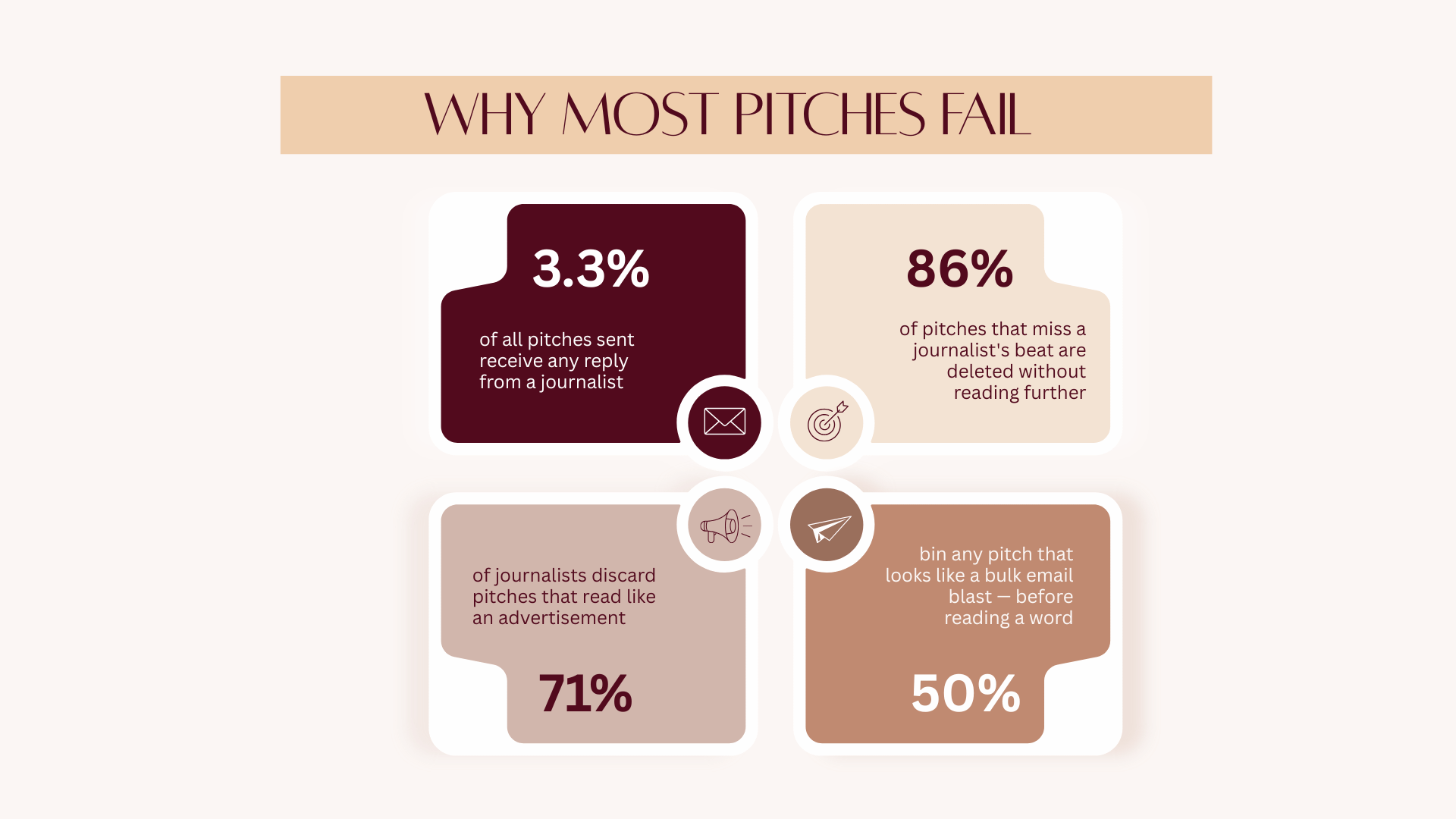
Relevance is the single biggest filter. Nearly half of all journalists say pitches relevant to their beat are rare or never happen, and when a pitch clearly misses the mark, 86% delete it without reading further. Pair that with broader industry data showing only 3.3% of pitches receive any reply at all (Demand Sage, 2025), and the picture becomes clear: most outreach fails before it even has a chance.
The other culprits are just as common and just as avoidable. Pitches that read like advertisements get discarded by 71% of journalists. Anything that looks like a mass email loses another 50%. These are not arbitrary preferences. They are signals that the person pitching did not do the work.
That sounds discouraging until you look at what those numbers have in common. Every single failure point is a choice someone made before hitting send: the wrong recipient, a weak and vague subject line, a pitch written for the brand rather than the reader. None of it is inevitable. Every one of them is within your control and are easy to fix once you know what to look for.
How to Write a Media Pitch Step by Step
Step 1: Find the Right Media Contacts
Before you write a single word, figure out who you are writing to. Research which journalists cover your industry, your region, or the specific topics your story connects to. Read their recent articles. Understand what kinds of story ideas they respond to and what their audience cares about.
Sending to the right person matters more than sending to many people. You can start with free tools like Google Alerts and LinkedIn. Search for journalists who have recently covered businesses like yours. If you are a minority-owned business, also look for reporters who write about entrepreneurship, diversity in business, or your specific industry. Build your media contacts list gradually, with quality over quantity.
Always keep in mind, sending to journalists who do not cover your space is the fastest way to burn a contact before the relationship even starts. The data makes this clear. BuzzStream’s 2025 research found that off-target pitches face a 73% rejection rate, while Muck Rack’s 2026 findings suggest the problem is even worse, with 86% of mismatched pitches being deleted without being read further. The takeaway is the same from both: five well-targeted contacts will always outperform fifty poorly matched ones.
Step 2: Write a Subject Line That Gets Opened
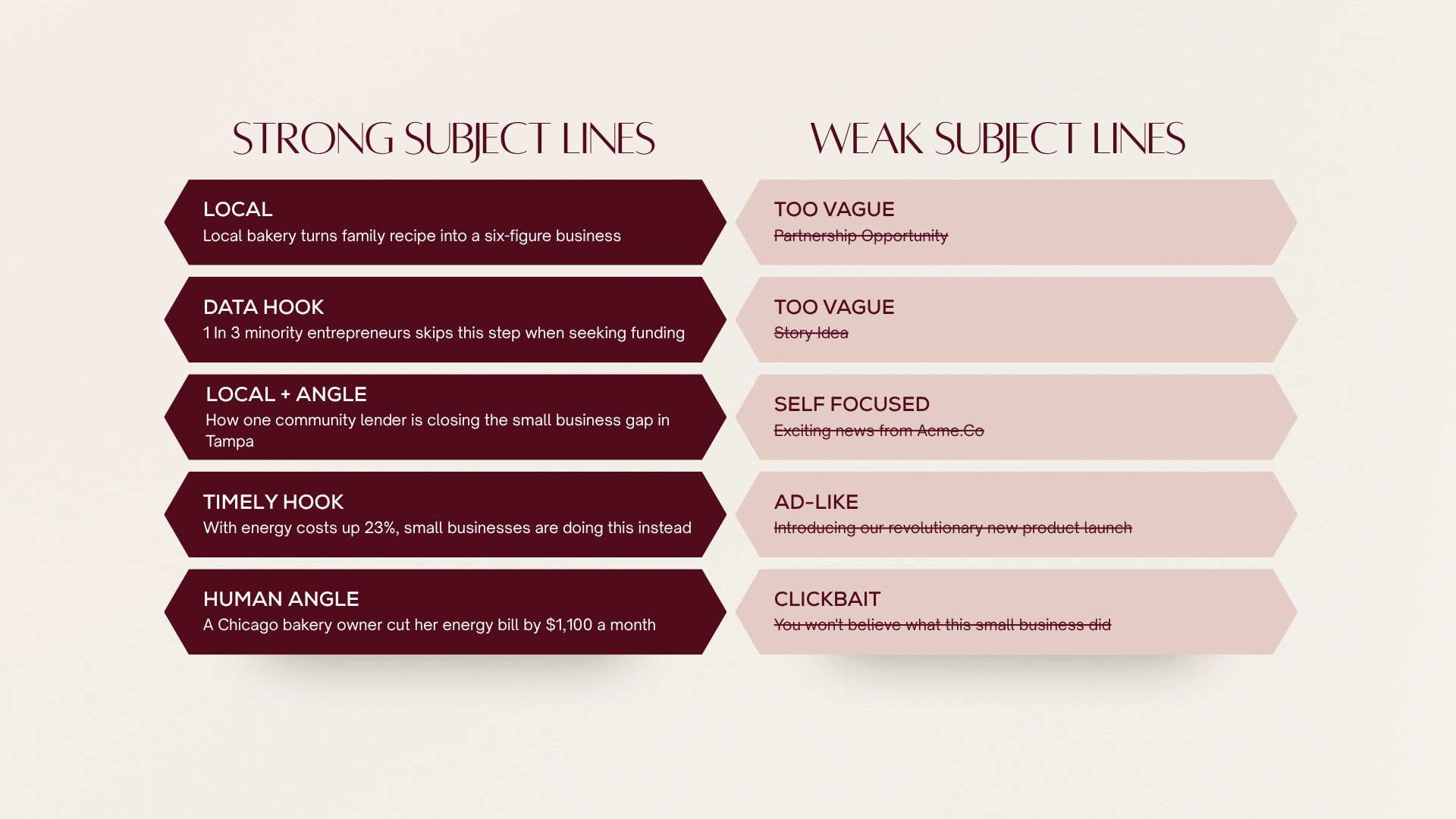
Your subject line is the most important line in your pitch. It determines whether a journalist even opens the email. Keep it under 10 words. Make it specific, not clever. Lead with the angle, not your company name.
Step 3: Open With Personalization
The first sentence of your pitch should show you have done your homework. Reference something the journalist wrote recently and connect it to why you are reaching out. This is not flattery. It is evidence that your pitch is relevant to them specifically, not a mass email.
For example: "I read your recent piece on small business financing gaps in communities of color and wanted to share a story that adds a local angle to that conversation." That one sentence does more work than three paragraphs of background about your business.
Step 4: Structure the Body of Your Pitch
Once you have the journalist's attention, you need to deliver the story quickly. Keep the entire pitch between 150 and 250 words. Use short paragraphs and, where helpful, bold your key points so they are easy to scan.
A strong pitch body covers four things in order:
• Context: What is the bigger picture your story fits into? What is happening in the world right now that makes this relevant?
• The story: What is the specific story you are pitching? Who is it about and why should their readers care?
• What you can offer: Can you arrange an interview? Do you have data, a real customer story, or exclusive access to share?
• Call to action: End with one clear, simple ask. "Are you available for a quick call this week?" or "I can connect you with our founder for an interview at your convenience."
Do not attach anything to a first pitch. No PDFs, no press releases, no images. Keep it clean and easy to respond to.
Step 5: Follow Up Once
If you have not heard back after five to seven business days, one follow-up is appropriate. Keep it to two or three sentences. Reference your original pitch and add one new piece of information if you can, a new data point, a recent development, or a timely hook that makes the story more relevant now.
After two total emails with no response, move on. Persistent follow-ups will get you blocked. Respect their time and they may come back to you when the timing is better.
Build Relationships, Not Just Coverage
The best media pitching is not a one-time transaction. It is the beginning of a relationship. Engage with journalists on social media by commenting thoughtfully on their work. Share their articles when they are relevant to your audience. Offer to be a helpful source even when you are not pitching a story.
When journalists trust you to deliver relevant, useful story ideas without wasting their time, they start reaching out to you. That shift from cold outreach to trusted source is when media relations really starts to pay off for small businesses.
If you are just starting out, do not try to pitch everyone at once. Pick two or three media contacts who genuinely cover your space. Write a pitch that serves their audience. Follow up once. Then do it again with the next story. Consistency over time is what builds a real media presence.
Get in Front of the Journalists Who Matter
At Verite House, we help small and minority-owned businesses develop media pitches that earn real results. From identifying the right journalists to crafting outreach that gets responses, we handle the strategy so you can focus on running your business. Get in touch today and let us help you get your story in front of the people who need to hear it.
Sources and Further Reading
1. Demand Sage: Digital PR Statistics 2025
2. Muck Rack: 2026 State of Journalism