What is media relations? A Complete Guide for Businesses
If you run a small business or work in marketing, you have probably heard the term media relations thrown around. But what is media relations exactly, and why should you care? In simple terms, media relations is the practice of building genuine, ongoing relationships with journalists, editors, bloggers, and other media professionals to earn positive, credible coverage for your brand. Unlike paid advertising, media coverage is earned, not bought. That distinction matters in a world where consumers are tuned out from ads but still trust what they read in the news.
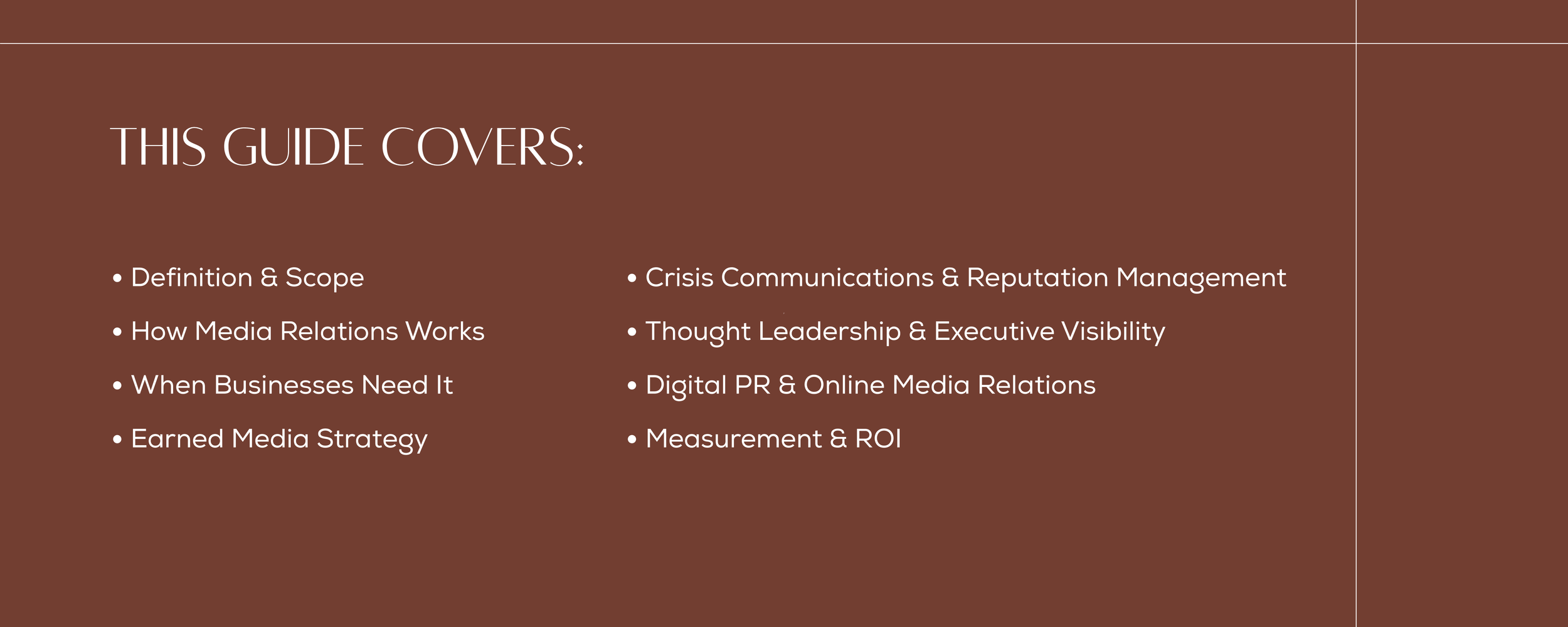
This guide covers everything: the definition, how media relations actually works, when your business needs it, the four core service areas (earned media strategy, crisis communications, thought leadership, and digital PR) and how to measure success Whether you’re just getting started or want to polish up your strategy, consider this your complete resource for mastering media relations.
What Is Media Relations? Definition and Scope
Media relations refers to the strategic, ongoing process of building and managing relationships between an organization and the people responsible for producing news and media content, including journalists, editors, producers, podcasters, bloggers, and influencers.
The main goal? To help get the word out about your brand’s mission, products, or activities in a way that’s positive, consistent, and credible, without directly paying for that exposure through advertising. As organizations define it: media relations involves working with media to inform the public of an organization's mission, policies, and practices in a positive, consistent, and credible manner.
Think of it like tending a garden. You plant seeds by reaching out with useful stories. You water them by maintaining relationships over time. And you reap what you sow through earned media coverage and positive brand perception. It’s not a quick-win tactic, it’s more of a long-term investment that continues to pay off as your relationships grow..
Media Relations vs. Public Relations: What Is the Difference?
The terms are often used interchangeably, but they are not the same. Public relations (PR) is the broader discipline. PR is the broader umbrella that covers everything to do with managing your brand’s reputation and communication. That includes social media, events, internal communications, investor relations, and community relations.
Media relations is a key part of PR, but it has a much sharper focus on your relationships with members of the press.
A useful way to think about it: PR develops the story. Media relations put that story in the hands of the journalists and outlets who can share it widely. Success in media relations is typically measured by how often your brand is featured in articles, interviews, and news segments, whereas public relations looks at the bigger picture, such as shifts in public perception, customer engagement, or business outcomes.
They work best in harmony. Your broader PR strategy defines your core message and goals. Media relations then takes that story to the right journalists, amplifying it with third-party credibility that advertising simply cannot replicate.
The Scope of Modern Media Relations
Gone are the days when media relations meant simply sending out press releases to print publications. Today’s media environment includes online publications, industry newsletters, podcasts, YouTube channels, influencer networks, and niche digital platforms. To be effective, a modern media relations strategy should cover all these bases and typically involves:
• Crafting and distributing press releases for newsworthy announcements
• Pitching story ideas to journalists, editors, and producers
• Building and managing a media database of relevant contacts
• Facilitating interviews, press conferences, and community outreach engagements
• Developing thought leadership through op-eds, expert commentary, and bylines
• Monitoring media coverage and tracking sentiment
• Managing crisis communications when reputations are under pressure
• Building links and online authority through digital PR campaigns
How Media Relations Works
Understanding the mechanics of media relations, not just the tactics, helps you set realistic expectations and build a more effective program. Here is how the process typically works, from first contact to published coverage.
To run a successful media relations program, it’s important to know more than just the individual tactics, you need to understand how the whole process works from start to finish which helps you set realistic expectations. Here’s a look at the typical flow, so you know what to expect every step of the way.
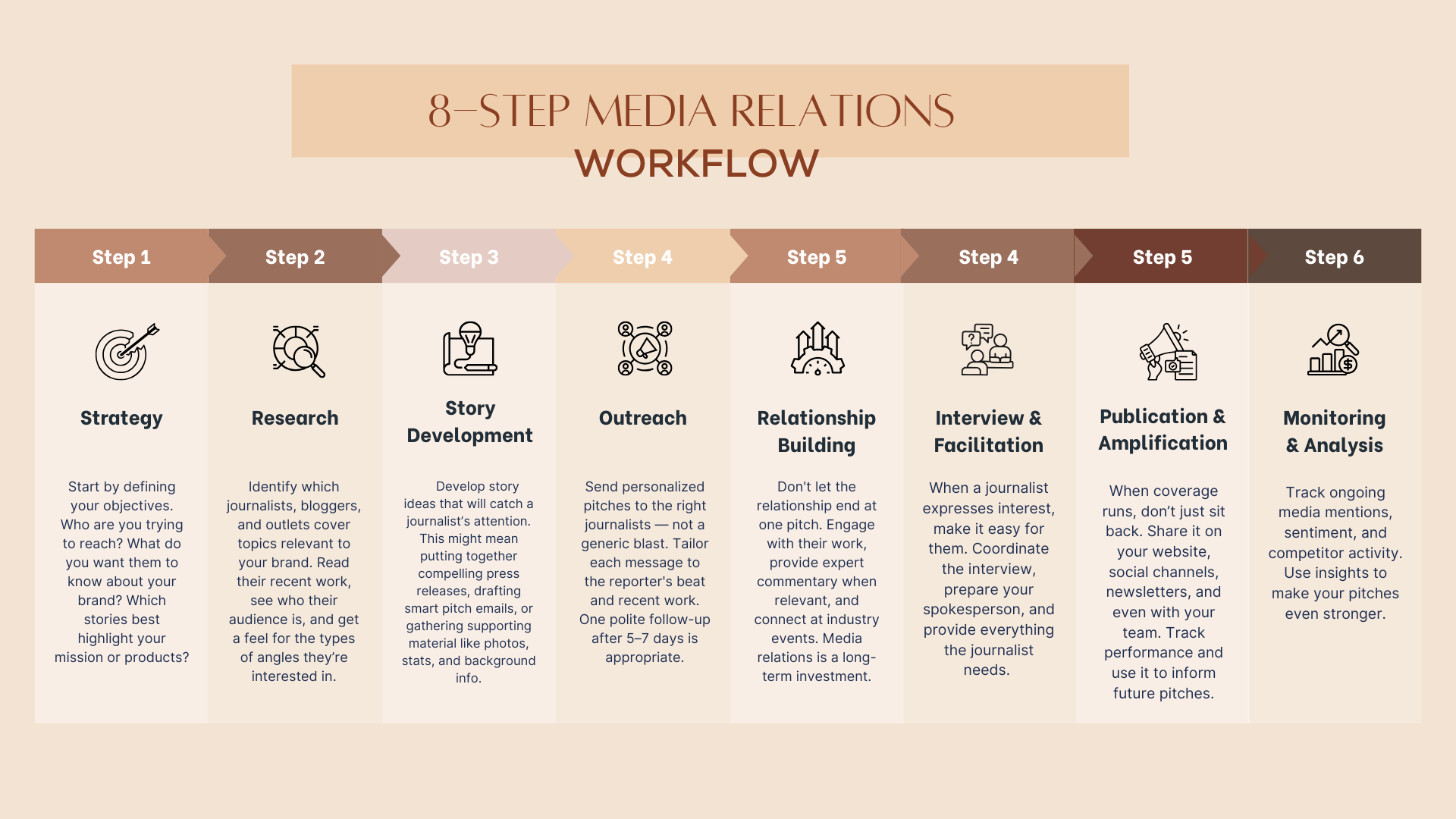
The Media Relations Workflow
A typical media relations cycle starts with strategy and ends with amplification. Here’s how the cycle usually unfolds:
The Journalist–PR Relationship
At its core, media relations is a two-way street. Journalists need stories: accurate, timely, relevant stories that their audiences will find interesting. PR professionals, on the other hand, need coverage, specifically exposure that builds brand awareness, credibility, and influence. When both sides understand and respect this exchange, it works well for everyone.
Problems arise, though, when PR professionals see journalists as just a distribution channel instead of professionals with insight and audience expertise. Sending mass, untargeted pitches, following up aggressively, or exaggerating the newsworthiness of a story all erode trust, and trust, once lost, is very hard to rebuild. According to the Cision State of the Media Report, three in four journalists say they would block someone who spams them with irrelevant pitches.
💡 The most successful media relations professionals operate with a service mindset: what can I offer this journalist that genuinely makes their job easier and their story better?
Earned, Owned, and Paid Media: Where Media Relations Fits
Media relations sits at the heart of earned media, which is coverage you receive because a journalist or editor finds your story is worth telling, not because you paid for it. The PESO model (Paid, Earned, Shared, Owned) provides a useful framework for understanding how earned media works alongside other channels:
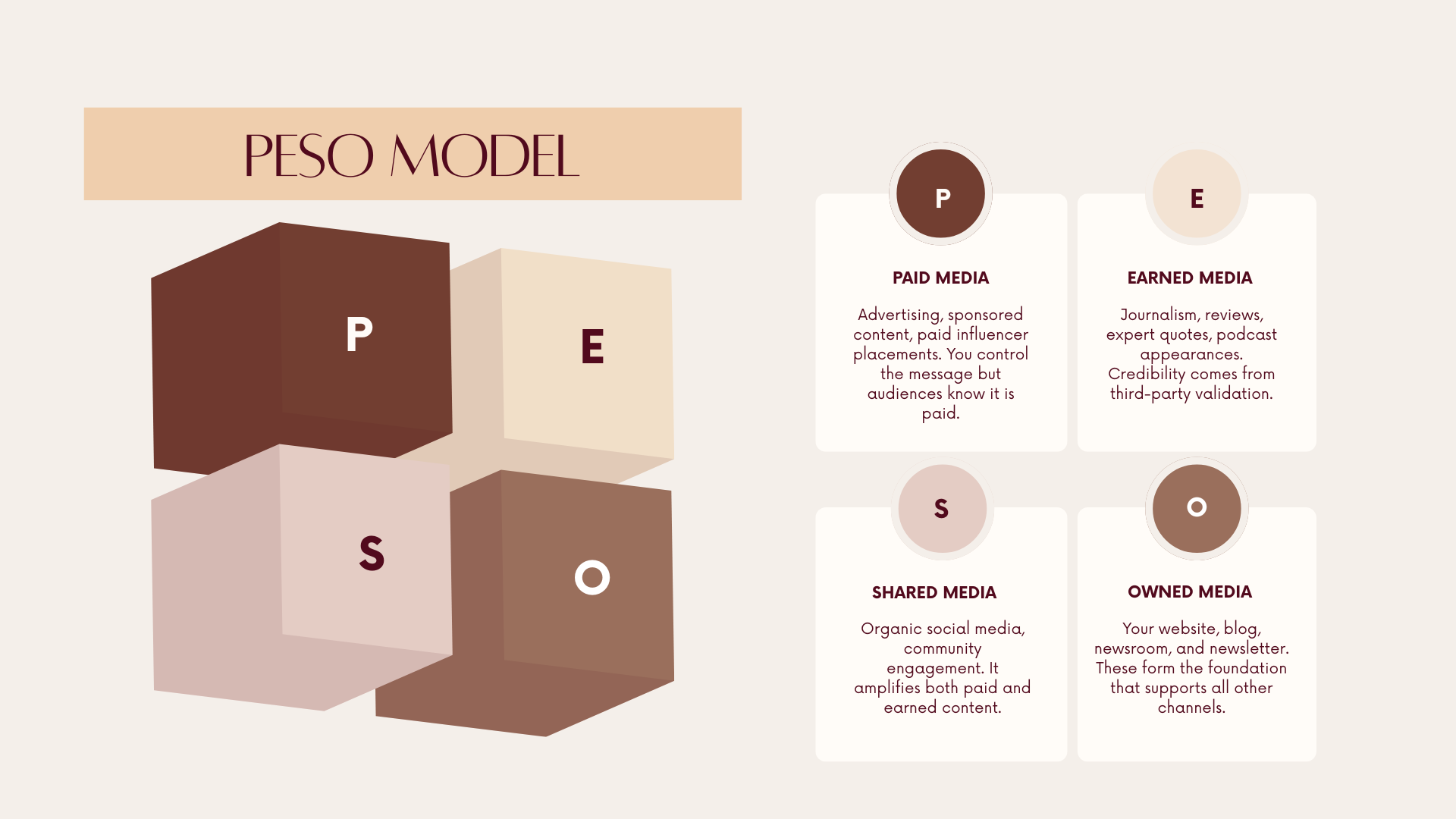
Media relations generates the earned media layer. Smart brands also use their owned channels to support media outreach, and their social channels to share and amplify any coverage once it lands. When these channels work together, the impact multiplies.
Why Media Relations Matters: Benefits and ROI
Here is the core argument for investing in media relations: people trust the news more than they trust advertising. When a respected journalist writes about your company, readers see it as an independent endorsement, not a sales pitch.
In fact, according to the 2025 Edelman Trust Barometer, 84% of shoppers now say they need to share values with a brand before they’ll make a purchase. In other words, value alignment isn’t just a nice-to-have anymore, it’s become a basic expectation in today’s marketplace.
These shifts aren’t just theoretical, they’re playing out in costly boycotts. By 2026, “value mismatches” have become a real financial risk:
Geopolitical Conflict: Starbucks lost $12 billion in market value and Coca-Cola’s sales in Turkey dropped 22% after regional boycott calls linked to the Gaza conflict.
DEI & Racial Equity: Target lost $12.4 billion in a month in early 2025 after rolling back DEI initiatives, prompting Black consumers and civil rights groups to boycott.
Immigration Rights: Home Depot faced national boycotts and the #HomeDeport campaign in 2025–2026 amid criticisms of its silence on immigration issues.
Advertising can’t fix a value crisis. Glossy commercials may feel like “purpose-washing” and erode trust even further. Only earned media—real coverage from independent sources—can show consumers authentic policy changes and community impact.
Unlike traditional marketing, earned media gives your brand credibility by offering third-party validation. It shows customers that your values are real, not just marketing copy, giving today’s savvy and skeptical shoppers the reassurance they need before they choose to support your brand.
Here are some of the biggest benefits of a strong media relations program:
1. Credibility and Trust
Coverage from trusted media is seen as more objective and reliable than self-promotion. For startups and small businesses, this is a huge asset when trying to establish legitimacy in a crowded market.
2. Brand Visibility and Reach
Getting your story placed in well-known and authoritative outlets puts you in front of new audiences far beyond what most paid channels could achieve on their own. And while paid ads disappear when the budget runs out, earned coverage sticks around in search results and archives.
3. SEO and Backlink Authority
When journalists mention (and link to) your brand, those backlinks boost your website’s SEO—sometimes significantly. A single mention in a top online publication can push your search rankings higher, making media relations one of the highest-ROI investments in your digital marketing mix.
4. Thought Leadership and Authority
Thought leadership articles published in major media outlets can boost audience engagement by as much as 55%, according to ClearVoice research. Once established as a recognized go-to source, journalists begin approaching you, completely flipping the dynamic.
5. Crisis Protection
Pre-built media relationships are your first line of defense when things go wrong. As Hugo Stienstra, Global Spokesperson at AkzoNobel, explains: if a journalist knows you, they will give you more time to respond or share your side of the story rather than publishing immediately. Those relationships, built in good times, pay dividends in difficult ones.
6. Talent and Stakeholder Confidence
Regular positive media coverage is a sign of a healthy, growing company. It boosts current employee morale, helps attract new talent, and reassures investors or partners. In other words, the value of credible press goes way beyond just sales, it builds confidence across your entire stakeholder ecosystem.
When Does a Business Need Media Relations?
Media relations isn’t just for large corporations with full-scale PR teams and agency retainers. In fact, there are specific points in any business journey when getting proactive with the media is especially valuable, and a few moments when it’s nothing short of urgent.
High-Value Moments for Media Outreach
• Product or service launch: media coverage drives awareness and lends credibility, especially before potential customers have tried your new offering themselves. However, journalists are less likely to go for these stories, as most pitches often are salesy and too product focussed.
• Community outreach: This can be any social function whether it be a fundraiser, give-away or a community event. These are the most widely chosen stories by journalists.
• Company milestones: anniversaries, significant growth figures, expansions, or awards all provide newsworthy hooks.
• Entering a new market: media coverage helps introduce your brand to audiences who may not know you yet, whether you’re expanding geographically or into a new sector.
• Thought leadership campaigns: when you have proprietary/unique data, a bold opinion, or unique expertise to share, media relations helps broadcast that to a wider audience.
• Reputation challenges: negative reviews, social media controversies, or competitor attacks all benefit from a proactive media strategy to balance the narrative and help set the record straight.
When Media Relations Becomes Urgent
Beyond planned campaigns, there are situations where media relations shift from strategic to critical. A product recall, a data breach, a public dispute with an employee or customer, an environmental incident, or any event that could damage public trust all require immediate, skilled media management. In these high-pressure moments, the relationships and protocols you have built through ongoing media relations become the difference between controlled, transparent communication and reputational crisis.
Rule of thumb: the best time to start building media relationships is before you need them. Organizations without established media contacts find themselves in a very difficult position when a crisis hits.
Earned Media Strategy
Earned media strategy is the core operational engine of media relations. It encompasses all the activities involved in researching, planning, creating, and distributing content to earn media coverage. Done well, it turns your organization's stories into news.
Media List Building
A media list is your curated database of journalists, editors, producers, and other media professionals relevant to your brand. And while it’s essential, it’s surprisingly overlooked. According to the 2024 Global Comms Report from Cision, only 22% of communications leaders feel confident in their team's ability to identify the right media contacts.
To build a strong list, read recent bylines, get familiar with each journalist’s beat, and organize contacts by reach: major outlets, industry specialists, and niche blogs. Use tools like Cision, Meltwater, or Muck Rack, and remember to update your lists regularly since journalists frequently change roles.
Press Release Distribution
Today, effective press release distribution means using both broad newswire services (like PR Newswire or Business Wire) and sending direct, personalized emails to reporters who really matter. For best results, aim for mid-morning on Tuesdays through Thursdays. Also consider the news cycle. Avoid pitching against major breaking news events that will crowd out your story, but look for moments when your announcement can ride the wave of relevant trending topics.
Media Pitch Development
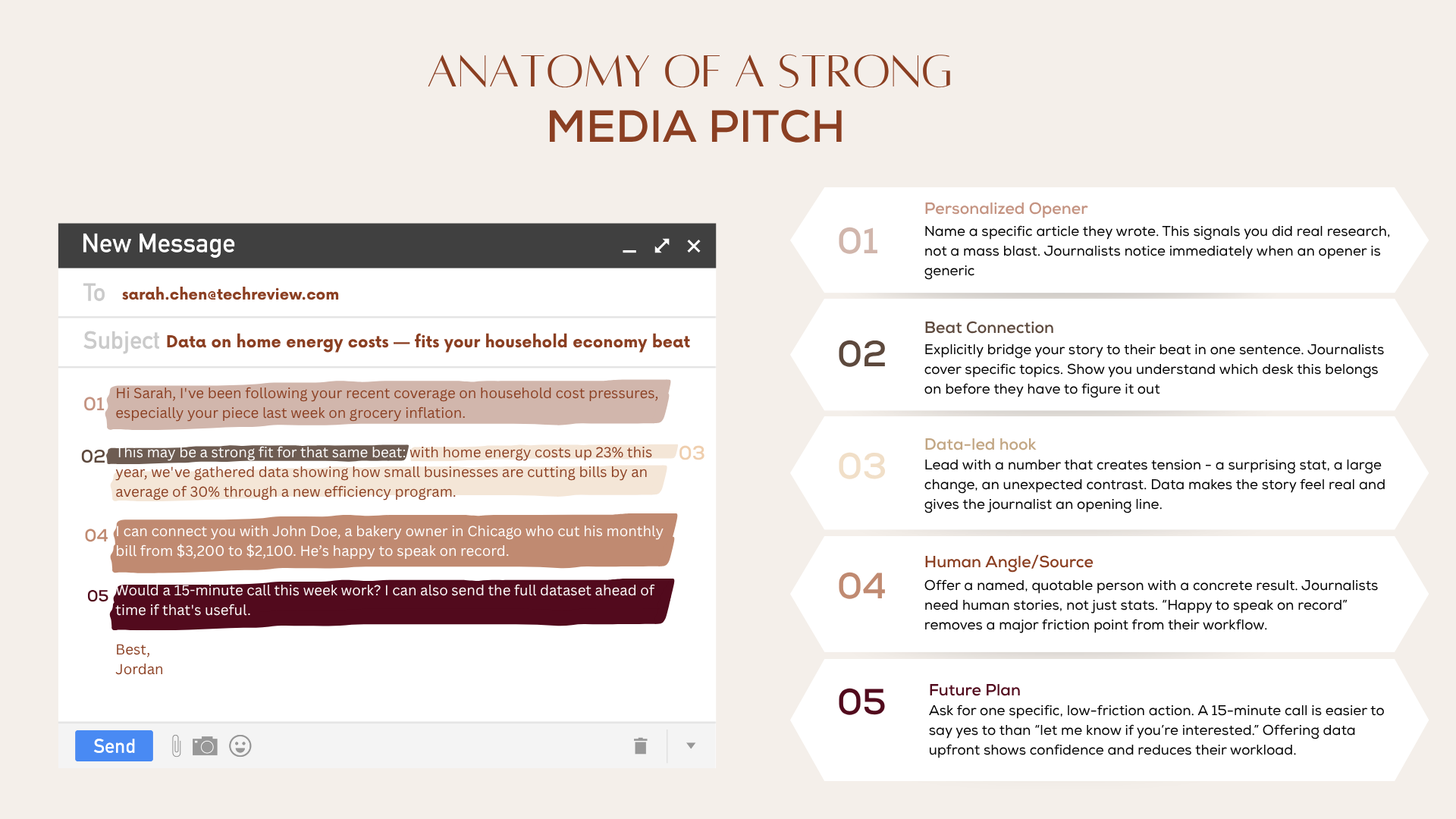
A pitch is a direct, personalized outreach to a specific journalist proposing a story idea. Unlike a press release, which is a formal announcement, a pitch is a conversation starter. It should be brief, no more than two to three paragraphs, and make the story's relevance to the journalist's specific audience immediately clear.
Strong pitches begin with a compelling angle, not a company announcement. Instead of "Company X has launched Product Y," a strong pitch frames a story: "With home energy costs up 23% this year, we have data showing how small businesses are cutting bills by 30%, and our CEO can speak to what is driving this trend." The company news is there, but it is contextualized within a story the journalist's audience genuinely cares about.
Personalization is non-negotiable. Reference the journalist's recent work. Explain specifically why the story fits their publication. Address them by name. This extra effort is what separates pitches that land from pitches that get deleted. Follow-up protocols matter too: one polite follow-up after five to seven business days is appropriate. Beyond that, move on. Repeated follow-ups damage relationships.
Editorial Calendar Alignment
Stay in tune with the industry: align your outreach to news cycles, seasonal themes, and publication editorial calendars (many share these in advance). Knowing what themes a publication plans to cover in the coming months lets you pitch timely, relevant stories that fit their existing plans.
Map out company updates in harmony with these windows for maximum relevance and attention. For example, a financial services firm might plan pitches around tax season, budget season, and annual reporting periods when their topics are most newsworthy. A retail business might build its calendar around back-to-school, holiday shopping, and post-holiday trends. Alignment with the news cycle dramatically improves pickup rates.
Spokesperson Development
Your spokesperson is the face of your brand in media interactions, and their performance has a big impact on how your story lands. Developing a strong spokesperson involves two key areas: media training and expert positioning.
Invest in media training so they’re comfortable answering tough questions across different mediums—TV, radio, digital, and podcasts. Keep in mind, about 55% of communication is non-verbal, so things like eye contact, posture, and body language matter just as much as the words themselves.
Expert positioning involves building your spokesperson's credibility and profile over time: writing guest articles, speaking at industry events, growing a professional presence on social media, and becoming recognized for insightful commentary in the media. Journalists love to quote reliable sources who really know their stuff, so consistent exposure helps your spokesperson become a go-to expert.
Story Angle Development
The “angle” is what makes your pitch newsworthy. Strong hooks include data, timely commentary on trending topics (“newsjacking”), human interest stories, or even a contrarian view.
If your business generates data through customer interactions, surveys, transactions, or operational metrics, narrating that data in a compelling way can earn you coverage and build thought leadership all at once. While journalists value data, they value community impact over everything. Your story should answer two questions: ‘What’s next?’ and ‘How can people take action?’
Journalists are always likely to cover a story that not only pertains to the geography of their audience, but also the geography of their proposed interview subjects. A journalist based in Tampa, Florida will likely not cover your story if you’re suggesting they do a satellite interview with an expert from Washington, D.C. Even though your story angle may very well impact Tampa specifically. According to Muck Rack’s State of Journalism 2024, 73% of journalists reject pitches because they’re not relevant to their coverage area. If you’re pitching a story angle, make sure all elements of the story align geography to the journalist you’re pitching to.
Media Monitoring
Media monitoring tracks what is being said about your brand, competitors, and industry across news, social media, broadcast, and podcasts. Use tools like Meltwater, Brandwatch, or Google Alerts to monitor what’s being said about your brand, your competitors, and your wider industry in the media and on social platforms. Make sure you have a process in place to actually act on what you find—being proactive here can make all the difference.
Crisis Communications and Reputation Management
Crisis communications is where media relations investments are stress-tested most visibly. It encompasses all the strategies, tools, and processes used to protect and if necessary restore your organization's reputation when it comes under fire. The companies that handle crises the best are nearly always the ones that took the time to prepare long before anything went wrong.
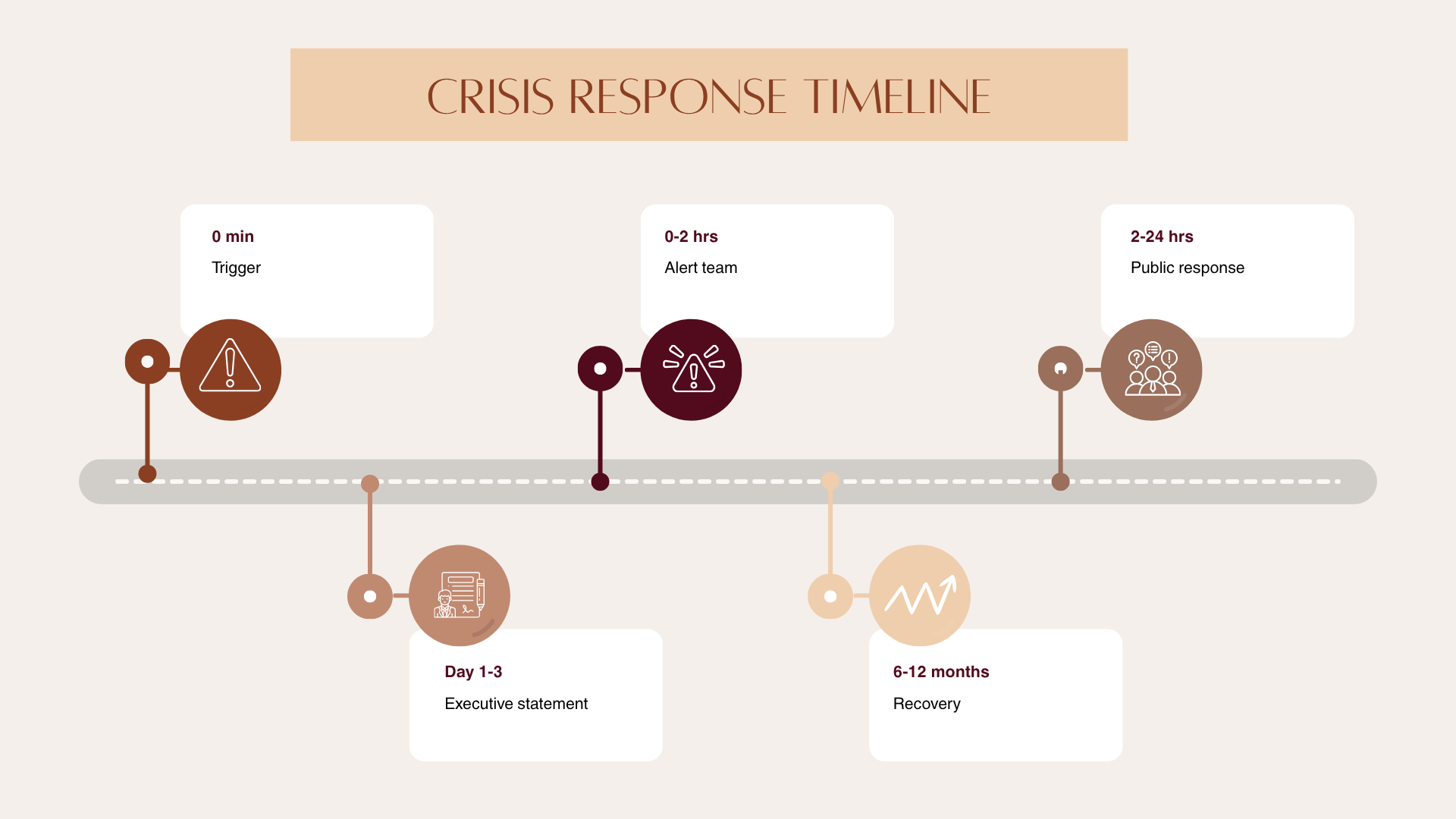
Crisis Response Planning
A solid crisis response plan spells out exactly how your organization will communicate if a major problem hits. This includes pulling together a crisis team with defined roles, picking primary and backup spokespersons, preparing holding statements and message templates, and making sure everyone knows the right approval process for public statements. Review your plan every year and after any major organizational changes.
Issue Management
Not every reputational challenge rises to the level of a full crisis. Often, it focuses on identifying issues early—whether that’s an emerging trend in media coverage or rumblings on social media—so you can handle them before they escalate. This requires early warning systems: media monitoring tools that flag negative sentiment spikes, social media listening for rising criticism, and regular stakeholder engagement to sense shifts in perception.
Use stakeholder mapping to figure out who cares about your actions and what concerns they might have. This lets you prioritize outreach and resolve issues before they become bigger problems.
Negative Media Management
When negative coverage appears, the first instinct is often to fight back or ignore it completely. Neither approach typically serves the organization well. First, check if there are factual errors. If so, you might request a correction. If not, see if there’s an opportunity to respond. A calm, transparent reply is almost always better than knee-jerk damage control; trying to bury legitimate criticism usually backfires.
Social Media Crisis Response
What might once have taken days to become a reputational story can now go from a single post to national media coverage within hours. That’s why it’s critical to have real-time monitoring, clear response guidelines, and specific templates for each platform (since a response on LinkedIn needs a different tone than one on X or TikTok). Having all this prepped in advance can save crucial minutes.
Platform-specific tactics matter. For example, a situation unfolding on X (formerly Twitter) usually calls for fast, concise updates and active monitoring of conversations. On LinkedIn, a more detailed and thoughtful statement, often delivered by a senior executive will be expected. When a crisis hits Instagram or TikTok, a video response from a recognizable spokesperson tends to resonate more than a written message. Having template responses tailored for each platform, ready to go (and easy to customize), can save critical time when every minute matters.
Executive Crisis Communication
In big crises, people want to hear directly from the leaders, not just the communication team. Make sure your senior team has regular media training (not just a one-time session) so they’re ready. The best crisis statements acknowledge what happened, show genuine concern, outline your next steps, and avoid guessing or speculating before all the facts are out. The cardinal rules: respond quickly, accept responsibility where appropriate, and communicate from the top.
Post-Crisis Recovery
Once the immediate crisis has passed, rebuilding trust is the priority. Post-crisis recovery involves ‘ systematic’ efforts, such as being open about the actions you’re taking, showing real evidence of improvements, and focusing on positive stories through earned media.
Long-term monitoring is essential during the recovery phase. Keep tabs on public sentiment for the next 6-12 months to ensure you’re making real progress. If sentiment is not recovering on the expected timeline, adjust the strategy. It just means that the remediation actions have not been communicated clearly enough, or that deeper organizational changes are needed.
Crisis Simulation Training
Crisis simulation training, often called tabletop exercises, is the practice of running realistic, scenario-based rehearsals of potential crises before they happen. They put your team under realistic, time-sensitive pressure, highlight any gaps in your plan, and include media role-play with tough questions. Simulations should cover scenarios specific to your industry and business, such as a data breach, a product safety issue, an executive misconduct allegation, or a supply chain failure. Even running one of these a year can reveal big improvements in how you’d respond if a real crisis hits.
Thought Leadership and Executive Visibility
Thought leadership is the strategic practice of positioning yourself or your company as recognized authorities in your field. It takes you from simply reacting to news to being the expert journalists seek out for valuable insights. For most organizations, building thought leadership is one of the most long-lasting and impactful investments you can make in your communications strategy.
Executive Profiling
Building up your senior leaders as recognized experts in their field starts with understanding where their real strengths and insights lie. Instead of just focusing on job titles, shape media bios around their unique expertise and perspectives. Clarify what topics they can speak on with authority, figure out which publications and platforms their ideal audience follows, and establish a regular stream of bylines, interviews, and speaking gigs to reinforce their expertise. Also, remember: a well-optimized LinkedIn profile goes a long way—many journalists use it to scope out potential sources.
Speaking Opportunity Development
Having your executives present at respected conferences or on industry panels does wonders for their reputation and credibility. These speaking spots instantly validate their expertise and open doors for media exposure in a way that self-published content cannot. Journalists covering the event are always looking for quotable leaders, and event organizers often help promote their speakers as well.
Start by crafting a compelling speaker bio and identifying the events most relevant to your audience. Pitch these organizers well ahead of time; most big conferences plan speakers six to twelve months in advance. If you’re just starting out, target smaller, more accessible events to build a solid speaking track record.
Byline Article Placement
A byline article is a piece published under your name in an external publication such as a trade journal, business magazine, or major online outlet. It is one of the most direct ways to display expertise and build credibility with exactly the audiences you want to reach. Unlike an interview where a journalist interprets your ideas, a byline gives you full control of the narrative.
Focus on publications your customers and peers actually read even if they're not the biggest names. Editors usually want a short summary or article idea first, so pitch them your angle before writing a full draft. Share genuinely useful insights, present new perspectives, or challenge conventional thinking. Just steer clear of self-promotion, as both editors and readers will spot it right away.
Award and Recognition Programs
Industry awards offer third-party validation that’s hard to beat. Being shortlisted or better, winning generates instant media buzz, boosts your brand’s credibility, and even uplifts your whole team. Yet, many organizations miss out simply because they don’t have a system for finding and applying to relevant awards.
Solve this by creating a calendar that maps relevant recognition programs in your industry, assigning someone to manage submissions, and investing time into well-written entries. Remember, being a finalist is newsworthy, too. Don’t hesitate to share that news.
Industry Commentary and Rapid Response
Some of the best media placements stem from being quick on your feet when journalists are fishing for expert input or quotes on a breaking story. Tools like HARO, Qwoted, or SourceBottle connect reporters with relevant sources at lightning speed. “Newsjacking”—adding your viewpoint to trending news—means reaching out to journalists within just a couple of hours. Those who respond first are most likely to land the interview or the quote. The window closes quickly: most journalists work with sources who respond within two to four hours of their initial inquiry.
Podcast and Media Interview Strategy
Podcasts are a huge opportunity for thought leaders, with millions of shows catering to every imaginable audience. Podcast strategy starts with identifying shows whose audiences align with your target market. Research the host's style, the typical interview format, and the topics that have performed best with their audience.
When pitching, offer a specific topic angle, not just your background. Prep talking points that genuinely teach or inform listeners, not just sell your story. Once your interview airs, promote it across your digital channels to maximize impact and show gratitude to the host.
LinkedIn Thought Leadership
For B2B leaders and brand executives, LinkedIn is a goldmine for building authority. Regular, insightful posts can reach thousands, including potential clients, partners, and media at little or no cost. Journalists often check LinkedIn for expert voices and to verify backgrounds. Focus on sharing original insights, thoughtful takes on industry trends, and engaged responses to others’ ideas. Consistency matters more than frequency: publishing two or three times per week with original insights outperforms daily posting of shallow content. And don’t forget your own profile. A clear headline, compelling bio, and proof of your expertise (like articles and media mentions) make a big difference.
Digital PR and Online Media Relations
Digital PR is the evolution of traditional media relations for the online world. It is the heart of how brands, including yours build brand's presence, authority, and visibility across digital channels, from online publications and podcasts to social media, influencer networks, and search results. Today, whether it’s through online publications, podcasts, social media, influencers, or how you rank in search results, digital is where media relations happens now.
Online Media Outreach
Online publications, email newsletters, and digital editions now reach far more people than traditional print. Online media outreach applies the same principles as traditional pitching (personalization, relevance, and timing) but requires additional awareness of SEO value, content formats, and digital publication workflows.
Online journalists move quickly and put out content more frequently. So if your pitch includes ready-to-use quotes, accessible spokespeople, and quality images or videos, you’re much more likely to see success than if you’re pitching like it’s a weekly magazine.
Link-Building PR
One of the most tangible benefits of digital media coverage is the backlink, which is a link from a media outlet's website to yours. In SEO terms, links from authoritative domains are among the most powerful signals that search engines use to rank websites. A single earned backlink from a major publication can be worth thousands of dollars in equivalent link-building spend
You can earn backlinks by sharing original research, creating data visualizations or interactive tools, or offering genuinely helpful resources reporters want to reference. PR campaigns built around your own data or industry insights often generate the best coverage and the most links.
Social Media PR
Social media does double duty in modern PR: it helps you connect directly with journalists—many of whom mine LinkedIn and X for story ideas, and it gives you channels to amplify your coverage once it’s out. On top of that, managing your online community and nurturing relationships with industry influencers are now essential parts of building your brand’s reputation.
Social media PR also involves community management: monitoring conversations about your brand and industry, engaging constructively with commentary (positive and negative), and identifying opportunities to insert your expertise into trending discussions. Influencer engagement, which means building relationships with individuals who have significant followings in your sector, increasingly blurs the line between social media PR and traditional media relations, as many influencers now generate coverage that rivals or exceeds traditional outlets in reach and audience trust.
Podcast Guest Placement
Unlike traditional media interviews where a journalist shapes the story, podcasts give you the rare chance to dive deep, usually 30 to 60 minutes, on topics that matter. Find the shows that reach your ideal audience, tailor compelling pitches for each show, prepare engaging talking points that deliver genuine value to the listeners, and manage the process from reaching out to follow-up after the episode airs. Tools like Podchaser and Listen Notes make it easier to seek out the right opportunities.
Online Reputation Management
Online reputation management (ORM) is the practice of monitoring and influencing what appears when people search for your brand, executives, or products online. Search engine results pages (SERPs) are often the first impression potential customers, partners, journalists, and employees form of your organization. Managing what they find is as important as any proactive PR campaign.
ORM involves: monitoring search results for your key terms on an ongoing basis; creating and optimizing owned content (website pages, blog posts, LinkedIn profiles, press releases) that ranks for your brand terms; securing positive media coverage that displaces negative content in search rankings; managing review platforms like Google Reviews, Trustpilot, and Glassdoor; and, in extreme cases, working with legal or specialist ORM providers when defamatory content cannot be addressed through standard channels.
Influencer Relations
Think of influencer relations as applying PR tactics to individuals with real influence on platforms, YouTube channels, podcasts, or niche. Don’t get hung up on follower numbers, relevance and engagement are more important. In fact, micro-influencers (with 10,000 to 100,000 followers) often bring more genuine endorsements than mega-influencers. Start by building real relationships and engage with their content before you ever ask for their help. This produces far better results than transactional, pay-for-post arrangements.
Content Amplification
Earning a media placement is not the end of the process. Every piece of earned coverage deserves to be amplified. When coverage runs, share it on your social channels and tag the journalist and outlet. Add it to your website’s press page, include it in your newsletter, pull out quotes for your sales team, and syndicate key insights to platforms like Medium and LinkedIn Articles. The more you share, the more value you get from your wins.
How to Measure Media Relations Success
Measuring the impact of media relations has long been a challenge, but it’s not just possible, it’s essential. If you want to show value, improve your strategy, and secure ongoing investment, you need a solid measurement approach.
The Right Metrics Framework
Start by tying your metrics to your main goals. Different goals call for different measures:
• For brand awareness goals: track media placements, reach (total potential audience), share of voice versus competitors, and sentiment
• For thought leadership goals: track byline placements, speaking invitations, expert quote requests, and LinkedIn follower growth
• For SEO and traffic goals: track backlinks earned, domain authority changes, and referral traffic from media coverage
• For lead generation goals: track assisted conversions from media referral traffic, inquiries citing media coverage, and sales influenced by earned media
Metrics That Matter
When it comes to measuring media relations, some key indicators truly show the impact of your efforts. Keep an eye on placements in your target publications, the quality and credibility of the coverage you’re getting, the number of backlinks earned, your share of voice compared to competitors, shifts in sentiment, website traffic coming from media coverage, how much your stories are being shared on social, and the number of interview requests your spokespeople receive. Track these on a regular basis, at least monthly, with quarterly strategic reviews.
One important note: steer clear of using Advertising Value Equivalency (AVE), which tries to put a dollar amount on earned media by equating it with the cost of ads. AVE is widely criticized because editorial coverage is received—and trusted—very differently from advertising. Focus on metrics that truly connect back to your business goals for the most meaningful results.
A Practical Media Relations Checklist
Use this checklist to keep your media relations program on track across all four service areas:
Earned Media Strategy
• Build and maintain a tiered media database, reviewed quarterly
• Set up media monitoring alerts for your brand, executives, competitors, and industry keywords
• Develop a six-month editorial calendar aligned to industry events and seasonal news cycles
• Create a press release template and approval workflow for rapid deployment
• Establish a bank of story angles and supporting data for proactive pitching
Crisis Communications
• Document your crisis response plan with team roles, escalation paths, and holding statements
• Identify and train primary and backup spokespersons
• Conduct at least one crisis simulation exercise annually
• Build platform-specific social media response templates for likely scenarios
• Establish a post-crisis monitoring protocol with defined recovery benchmarks
Thought Leadership
• Optimize executive LinkedIn profiles for discoverability and expertise signaling
• Build a byline placement calendar targeting two to four articles per quarter per executive
• Identify and submit to relevant industry awards with a dedicated submissions calendar
• Set up HARO or Qwoted alerts for journalist source requests in your areas of expertise
• Develop a conference speaking submission pipeline targeting events six to twelve months out
Digital PR
• Audit your search results monthly and identify negative or missing content to address
• Design at least one original data or research asset annually for link-building campaigns
• Build a podcast guest placement target list and develop a pitch template
• Establish an influencer identification and relationship-building process
• Create a systematic content amplification workflow for every earned media placement
Final Thoughts: Media Relations Is a Long-Term Investment
So, what is media relations in practical terms? It is one of the most cost-effective, credibility-building strategies your business can invest in, as long as you approach it with patience, smart planning and genuine authenticity.
Modern media relations spans four interconnected domains: earned media strategy that turns your stories into news; crisis communications that protects your reputation when it is under fire; thought leadership that builds the authority and visibility of your executives and brand; and digital PR that amplifies everything you earn across the platforms where your audiences actually spend their time.
The media landscape continues to shift. It is more digital, more fragmented, and more competitive than ever. Yet the foundation remains unchanged: build real relationships with real journalists by providing genuine value. Understand what they need. Learn what they are looking for. Make their jobs easier. Tell stories their audiences care about.
Warren Buffett once said, “It takes 20 years to build a reputation and five minutes to ruin it.” Media relations, done well, is one of the most powerful tools for building that reputation steadily, credibly, and durably, and defending it when the pressure comes. Start planting those seeds today.
Your brand’s story deserves to be told, across the right platforms and to the right audiences. If you're ready to elevate your media presence, we’d love to show you how. Connect with us today to start crafting a media strategy that stands the test of time.
Sources and Further Reading
Cision: Media Relations - What Is It and Why Is It Important?
Cision: 2024 Global Comms Report
Cision: State of the Media Report