How to Get Earned Media: A Practical Guide for Small Business Owners

Close to $75 billion. That is what the top 10 US advertisers will spend on paid media this year. Amazon, Procter and Gamble, and their peers have entire departments dedicated to buying visibility. For context, that is enough to fund most small businesses for several lifetimes over. And yet, for all that investment, the most credible voice in any buying decision is still one that was never paid to speak: TRUST
That is not a hunch. A 2026 ICERTIAS report highlights how consumers now lean heavily on user-generated content, social proof, and independent news sources to validate what brands tell them. Trust has moved. And for small and minority-owned businesses willing to meet consumers where that trust now lives, earned media is the most direct path there.
For minority-founded businesses, the stakes go beyond visibility. Black-owned businesses contribute over $215 billion to the US economy and are still denied traditional credit at nearly twice the rate of other firms, according to the 2026 Small Business Credit Survey.
The good news is you do not need a big budget or a PR agency to get started. What you need is a clear strategy, a compelling story, and the patience to build the right relationships. This guide walks you through exactly how to do that.
What Is Earned Media?
Earned media is any coverage your business receives that you did not pay for. A journalist writes a feature on your company. A podcast host invites you as a guest. A customer shares their experience on social media and it spreads. A blogger mentions your product in a roundup. All of this counts.
It is called "earned" because you cannot simply buy it. You earn it through a good story, a genuine relationship, or content that people actually want to share. That is also why it carries so much weight. According to Presspage, 92% of people trust earned media over any form of advertising. When someone else vouches for your business, their audience listens in a way they never would with a paid ad.
Why Earned Media Matters More for Small Businesses
For large corporations, earned media is one channel among many. For small businesses, it can be the channel that changes everything. A single well-placed feature story can drive more website traffic, leads, and credibility than months of social media posting.
This is especially true for minority-owned businesses. Research consistently shows that underrepresented entrepreneurs face greater barriers to visibility. Earned media coverage helps level that playing field. It introduces your business to audiences that might never have found you otherwise, and it does so through a trusted third-party voice rather than your own marketing.
Beyond visibility, earned media coverage also supports your SEO. Every time a publication mentions your business and links back to your website, it signals authority to search engines. Over time, that compounds into better organic rankings and more traffic without ongoing ad spend.
How to Get Earned Media: 5 Steps That Actually Work
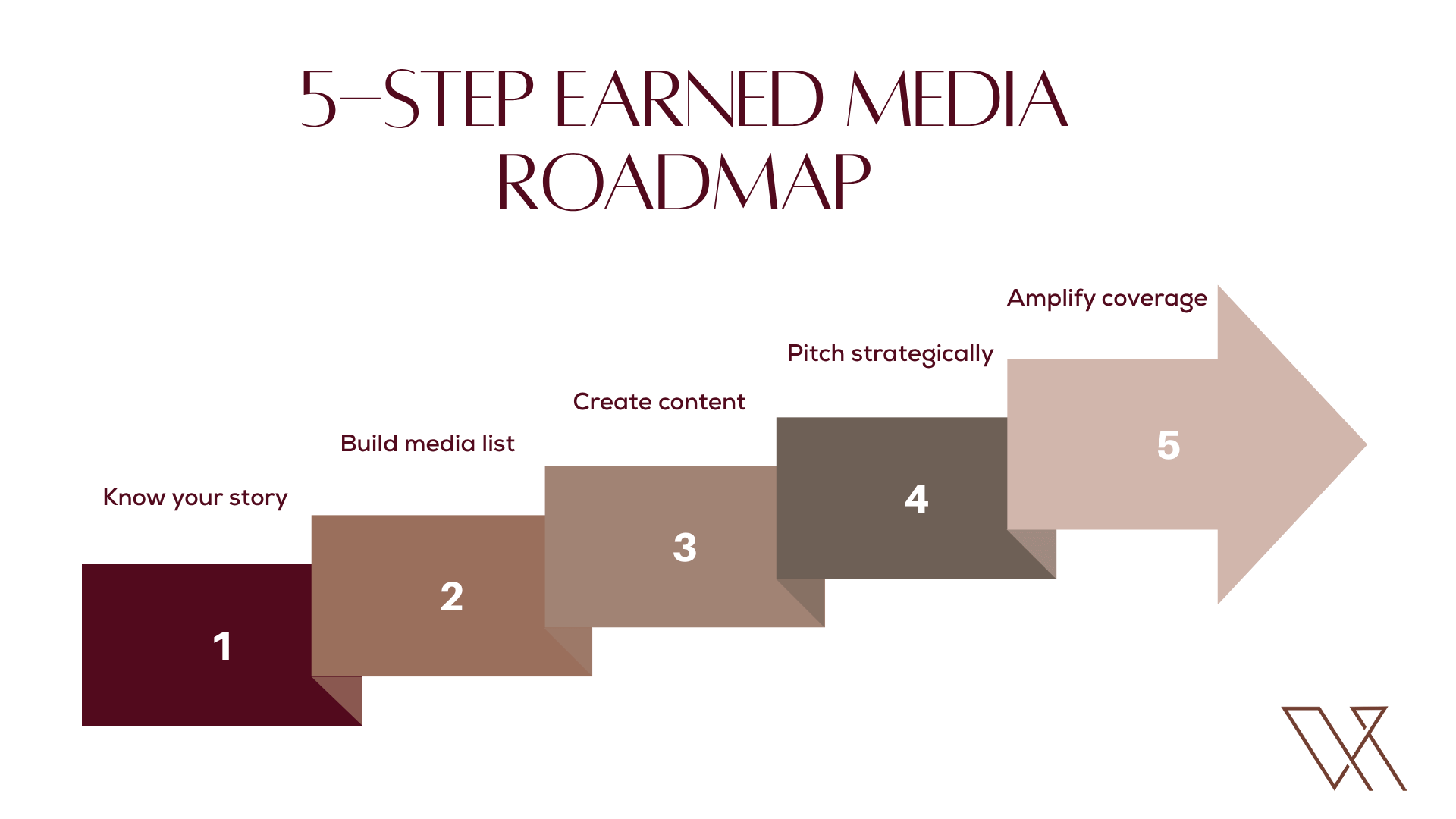
1. Know Your Story and Who Needs to Hear It
Before you pitch to anyone, get clear on what makes your business genuinely newsworthy. Not every update qualifies. A grand opening, a community milestone, original data from your own customers, a response to a trend affecting your industry, or a founder story rooted in your community can all be strong angles.
The key question to ask is: why would a journalist's readers care about this right now? If you cannot answer that clearly, the pitch is not ready. Journalists are building trust with their audience every time they choose what to cover. Your story needs to serve their readers, not just your brand.
For minority-owned businesses in particular, your founder story and community roots are often a genuine differentiator. Reporters covering entrepreneurship, economic inclusion, or local business development are often actively looking for stories like yours. That is a real opening worth pursuing.
2. Build a Targeted Media List
Start small and be specific. Identify five to ten journalists, editors, or content creators who actually cover your space. Read their recent work. Look at what kinds of story ideas they respond to and what their audience cares about.
Do not try to reach everyone at once. A pitch sent to the wrong journalist is not just wasted effort; it can damage your credibility with that outlet. Quality of outreach matters far more than volume. One well-researched pitch to the right person beats a mass email to fifty contacts every time.
Local business reporters, trade publications in your industry, community-focused newsletters, and podcast hosts in your niche are all worth targeting. These outlets are often more accessible than national media, and the audiences they reach are frequently more relevant to your business anyway.
3. Create Content Worth Covering
Earned media coverage does not happen in a vacuum. It usually follows a pattern: you create something worth talking about, and journalists or influencers talk about it.
That might mean sharing original data from a customer survey. It might mean publishing a thoughtful perspective on a trend affecting your industry. It could be a case study showing measurable results your business achieved for a client, written in a way that is useful to others. It could even be a community event or initiative that has a real impact.
The common thread is genuine value. Content that informs, challenges conventional thinking, or solves a real problem tends to attract media attention naturally. Content that reads like a press release for your own company rarely does.
4. Pitch With Personalization and Purpose
When you are ready to reach out, keep your pitch short and specific. Two or three paragraphs maximum. Open by referencing something the journalist has recently written, then explain why your story is a relevant next step for their audience. Close with one clear ask.
Do not attach anything to a first pitch. Do not use generic subject lines. And never send the same pitch to multiple journalists without customizing it. Journalists can spot a mass email immediately, and it will end the conversation before it starts.
If you do not hear back within five to seven days, one polite follow-up is appropriate. After two total emails with no response, move on. Persistence is a virtue in media relations, but so is knowing when to redirect your energy.
5. Amplify the Coverage You Earn
Getting a media placement is only the beginning. Once coverage runs, the real work is making the most of it. Share it across your social media channels. Feature it prominently on your website. Include it in your email newsletter. When you send proposals or pitches to potential clients or partners, reference your media mentions.
Coverage that sits unshared loses most of its potential value. Coverage that is actively promoted keeps building trust with your audience long after the original publication date. Each placement also makes the next one easier: journalists are more likely to cover a business they can see has already been covered elsewhere.
Building Trust Is the Long Game
The businesses that earn the most media coverage over time are not necessarily the ones with the most news. They are the ones that show up consistently, build genuine relationships with journalists, and treat every interaction as an investment in a long-term connection rather than a one-time transaction.
Follow journalists on social media and engage thoughtfully with their work. Share their articles when they are relevant to your audience. Offer to be a helpful source on topics you know well, even when you have nothing specific to pitch. That kind of ongoing relationship is what eventually turns a cold pitch into a warm one.
If you are a small or minority-owned business just starting out with media relations, choose one tactic and do it well. Identify one journalist who covers your space. Write one strong pitch. Send it, follow up once, and learn from the result. Then do it again. That is how earned media coverage grows.
Ready to Start Earning Your Coverage
Media relations is not a sprint — and the brands that treat it as one rarely cross the finish line. The most powerful visibility is built quietly, consistently, and with a long view in mind. If you're the kind of business owner who understands that real influence takes time, and you're ready to invest in a strategy that compounds — we should talk. Vérité House doesn’t chase coverage. We build the kind of presence that makes coverage inevitable.