Start with where attention actually sits. Across 48 markets, the Reuters Institute’s Digital News Report 2026 found that 69% of people use YouTube and 67% use Facebook for some purpose, 53% use Instagram, and TikTok has climbed from 15% to 37% in the five years since the pandemic. Creators live inside all of it. More than a quarter of that same global sample, 27%, now get information from news creators every single week.
So the logic businesses are following makes sense. The audience moved, the people they trust moved with them, and a recommendation from someone a buyer already follows lands differently than a banner ad ever could. Awareness, discovery, and in a good month, sales. That’s why creator outreach has stopped being a beauty-brand tactic and started showing up in the plans of accounting firms, clinics and product companies.
The appeal is real. What usually follows, is not.
Here’s how it tends to go. Ad costs creep up, reach on your own account flattens out, and then someone notices that a creator mentioned a competitor and the comments are filled with people asking where to buy. That looks like the answer, and it looks cheap. By the end of the week there’s a list of names in a spreadsheet, a draft email, and a plan to send it to 40 people on Monday.
I would bet most of those 40 never reply, and the reason has almost nothing to do with the email.
Most influencer outreach fails before anyone writes a word, but not in the subject line and not in the pitch. Rather, in the decision about who to contact and on what basis.
A quick note on vocabulary, because it gets muddled constantly. Influencer outreach is the act of contacting a creator to propose working together. Influencer relations is the ongoing practice of building and keeping those relationships. Most businesses do the first and call it the second.
Now to the part that actually changes your results. Every creator relationship enters through one of three doors: earned, gifted or paid. The door you walk through decides what you can reasonably ask for, how much say you get over the result, what you’re legally required to disclose, and what you can honestly measure afterwards. Choose the door first. Almost everything else follows from it.
So this guide covers how to pick the right creators, what a message that gets answered actually contains, how to follow up once, and the disclosure obligations that apply to you whether or not anyone has mentioned them. What it will not do is hand you a copy-paste template, and I will explain why when we get there.
What creator attention can and cannot buy you
The same Reuters Institute research found something less flattering than the reach figures: while creators are seen as more entertaining and easier to understand than traditional media, the general population tends to view them as less trustworthy and less impartial.
That matters, because creator marketing is usually sold as a way to buy credibility. More often it buys attention, but attention and trust are not the same purchase.
However, none of which is a reason to skip it. Reaching a specific audience through someone they already listen to is genuinely valuable, and it’s frequently the most realistic way for a small business. Just don’t mistake it for the third-party independent coverage gives you, which our guide to digital media relations covers properly.
The Three Doors: earned, gifted and paid
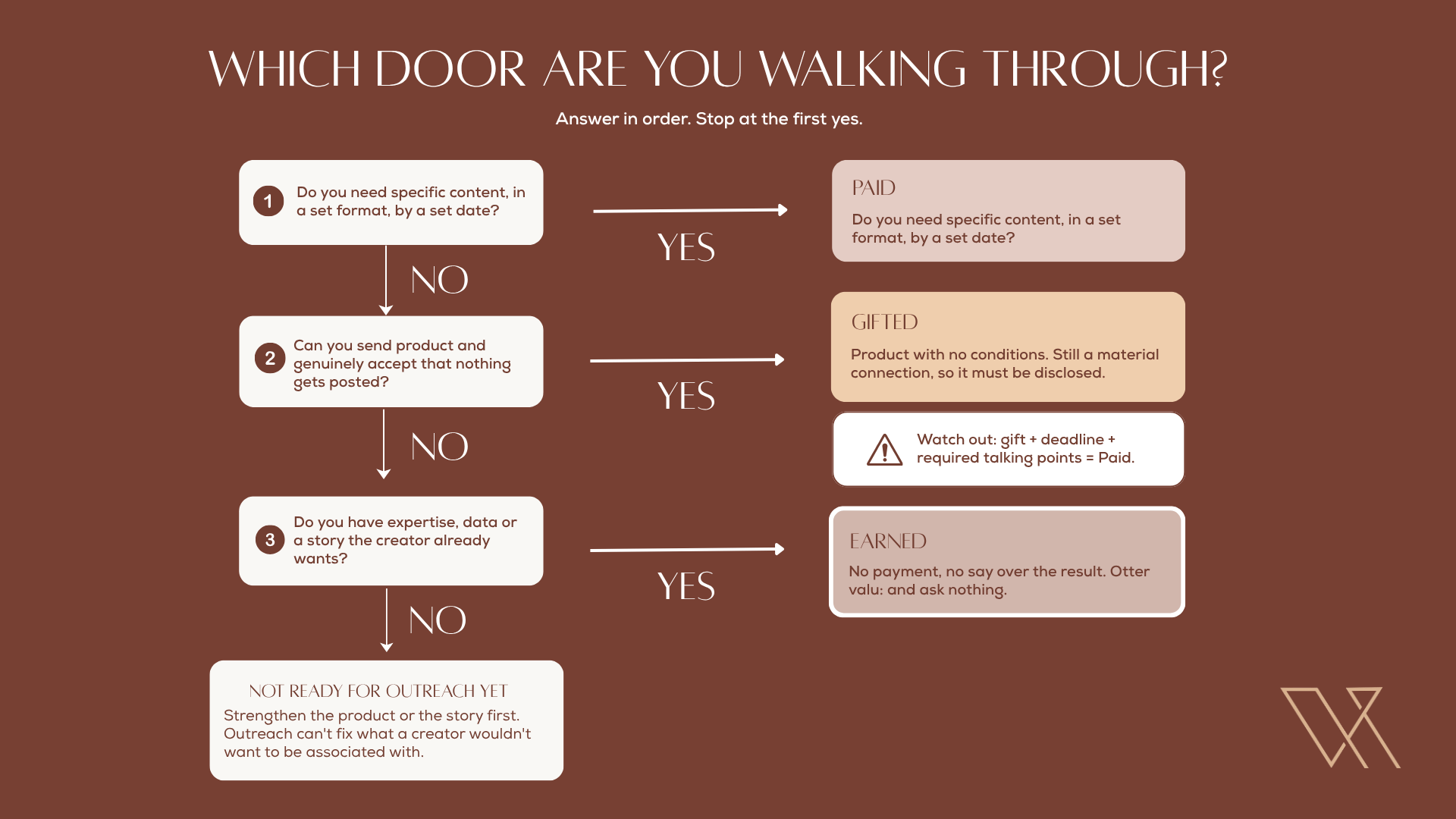
But there are three things that matter more than the table itself…
The doors are not a ranking. Paid is not what you settle for when charm fails. If you need a particular message, in a particular format, by a particular date, you are describing a paid relationship, and trying to get there through goodwill wastes everyone’s time including yours.
Most outreach problems are a confusion between doors. A business sends a free product. Then asks for a post within two weeks, in a set format, mentioning three features. That is a paid relationship, and the creator reads it exactly that way. A gift with conditions attached is not a gift.
Relationships move between doors, and the good ones usually do. A creator who mentioned you unprompted makes a far better paid partner later, because her audience watched that relationship develop rather than arriving mid-transaction. Knocking on the paid door is faster. Knocking on the earned door lasts longer.
If you want a bigger picture of how a creator's work sits alongside advertising, your own channels and community…. Our guide to paid, owned, earned and shared media lays out the full model.
Choosing creators: the relevance test
Targeting decides the outcome, and it’s the part almost everybody rushes. Work through these before you write to anyone.
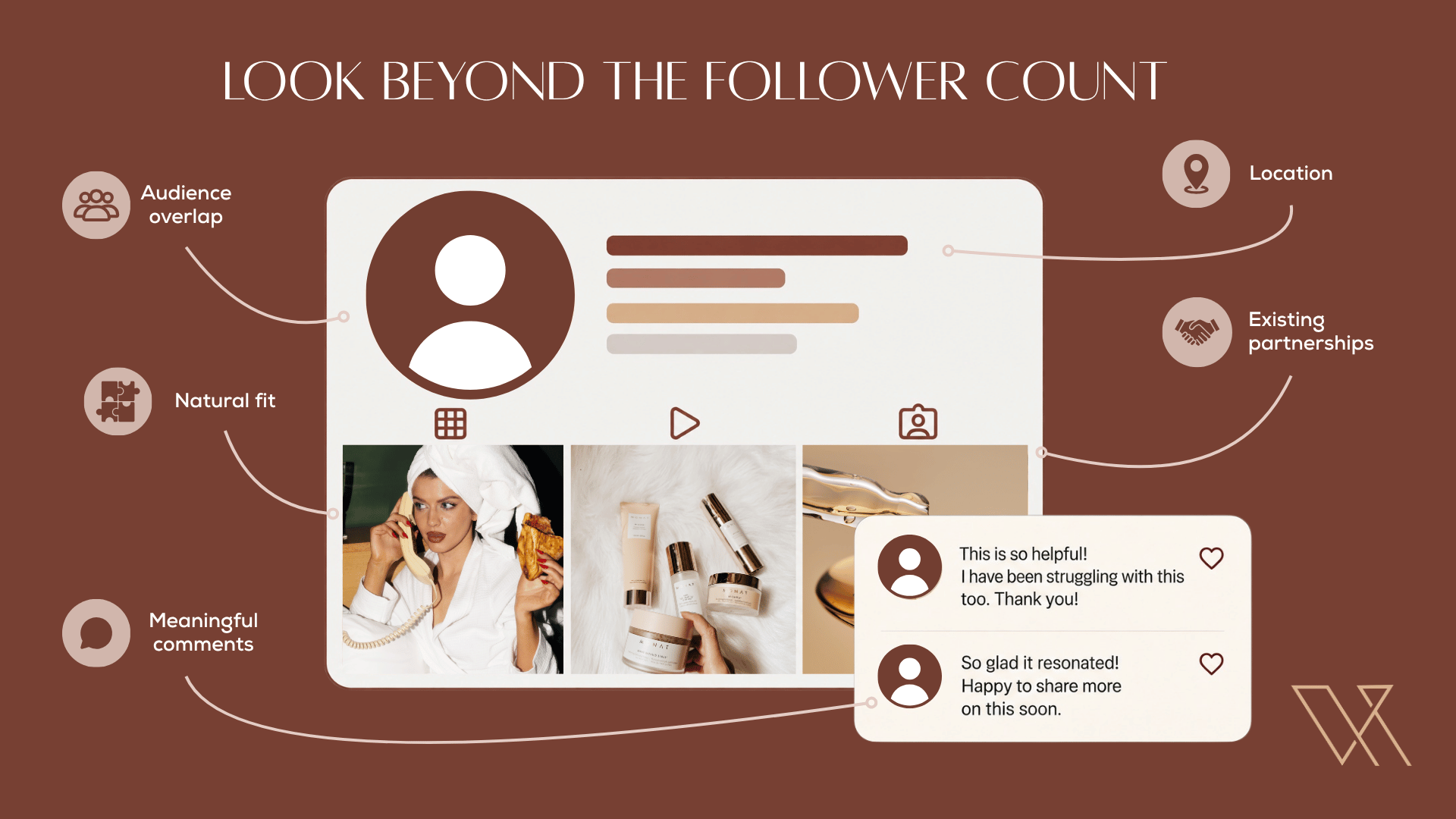
Audience overlap. Not whether their audience is big, but whether it contains the people you need. A creator with 4,000 followers who are mostly your customers, beats one with 200,000 followers who mostly are not. Follower count is the least useful number available to you and the first one everybody looks at.
Natural fit. Scroll through their last 10 posts. Does your product belong in their feed, or would it be totally random or irrelevant? If you need a paragraph to explain the connection, their audience will need one too.
Engagement substance. Read the comments, do not count them. Are people asking questions, swapping experiences, replying to each other? Or is it a back and forth with a wall of emojis? 20 real conversations tell you more than a high engagement rate.
Location and market. An audience in the wrong country is reach you cannot use. Check this before you fall in love with the content, not after.
Existing partnership load. Check their recent sponsored posts. If a creator has run three competitors in your category this quarter, her audience has already learned to scroll past sponsored content from that account.
Reputational risk, kept in proportion. Read enough of their history to know what you’re associating with. This is not a background investigation, and treating creators as liabilities to be screened is both insulting and obvious from the outside. But association runs both ways, and having thought about how you would respond to negative publicity before anything happens beats any amount of vetting afterwards.
One more, and this one is legal rather than editorial. Buying or selling fake indicators of influence, including bot-generated or hijacked followers, is prohibited under the FTC’s rule on consumer reviews and testimonials, which took effect in October 2024.
Research before you contact anyone
Before you write anything, know this much: what this person actually posts about, who their audience is, whether they have worked with your competitors, and how they prefer to be approached.
That last one matters more than people expect. Plenty of creators publish contact preferences. Email only. Management only. Sometimes a flat statement of what they will not accept. Ignore it and you are deleted, fairly, because you have just shown them how the rest of the relationship will go.
Then, figure out why this person would want to hear from you—not why you want to reach them. Those are two different questions, and only one of them is interesting to the recipient. The things that make a story worth a journalist’s time are mainly the same reasons that are worth a creator’s time. Our guide to what makes a story newsworthy is a reasonable place to start if you don’t know the answer.
What a good influencer outreach message contains
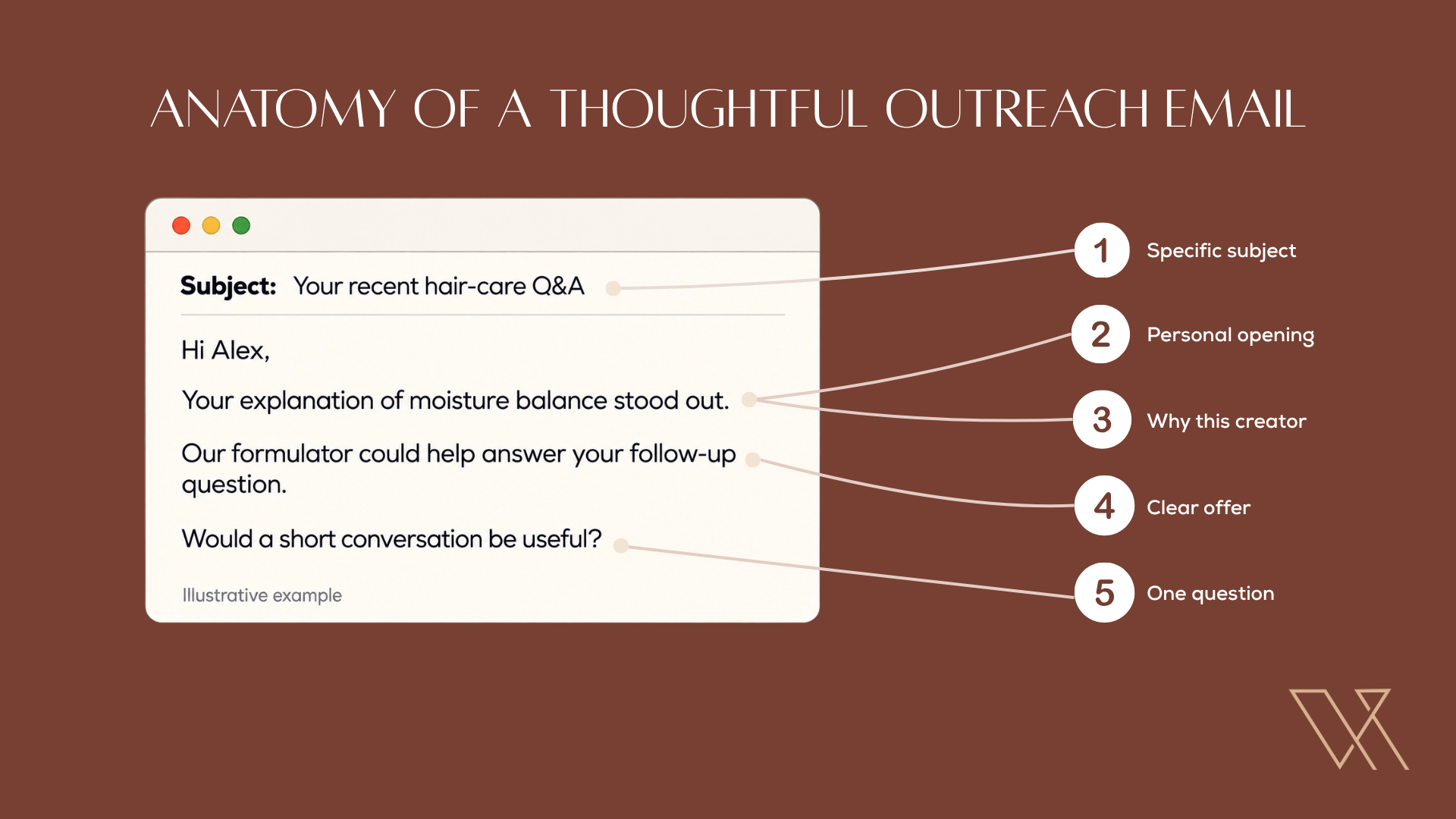
Five parts, roughly in this order.
A subject line that is specific. Name the thing, not the feeling. A line that could have gone to a hundred people will be read as having gone to a hundred people.
An opening that proves you watched. One sentence about actual content. Not “I love your content,” which every creator has received several hundred times. Name the video and name the point they made, ideally the one that connects to what you plan to ask them.
The reason you chose them. Why this creator, specifically. If you cannot answer that in a sentence, go back to understanding the creator’s audience.
What you are offering, and which door. Say what kind of relationship you’re proposing, concisely. If there’s a fee, name the number. If it is a product with no obligation, say that and mean it. If what you have is access, data or an expert rather than money, say so plainly. Vagueness here reads as either inexperience or a negotiating tactic, and neither helps you.
One clear ask, and nothing attached. Ask a single question they can answer. Send no brief, no deck, or a PDF. All of that waits until they ask for more information. Then stop. The whole message should be readable in under 30 seconds.
If this feels familiar, it should. The discipline is close to pitching a journalist, which our guide to writing a media pitch covers. Two differences matter: creators are usually running their own business rather than answering to queries, and a creator relationship often involves a monetary or gift exchange, where a journalist relationship would never.
Why there is no template here
Templates can sometimes create a problem they claim to solve. Swap in a name and a reference and the people receiving it recognize the shape of it before the second sentence. Use the structure above and write each message yourself.
Two illustrative messages
Both are labelled examples. Neither was sent, and neither carries a result.
Example one: the earned door
Subject: Your protein-moisture question from Thursday
Hi [name],
You raised a question on Thursday about why protein treatments leave some transitioning to stiffer rather than stronger hair. Our formulator has a specific answer to that, and I thought you might want it, whether or not anything comes of this message.
We make [product] here in Houston. I’m not asking you to post about it. If it would be useful, I can put you on a brief call with the founder of [product], or send the product so you can judge it yourself, with no expectation either way.
Would either be useful?
[name]
What this message is doing: offering something the creator asked for in public, making the absence of obligation explicit twice, and asking one question. The door is named by what’s absent, as much as by what is said.
Example two: the gifted door
Subject: The two-strand twist breakdown, and a product question
Hi [name],
Your two-strand twist breakdown last month was the clearest explanation of tension I have seen, particularly the part about where people actually lose length.
We are a four-person hair care brand in Houston. I would like to send you our transitioning line, as a gift with no obligation to post anything. If you do decide to post, we would kindly ask that you mark the product as gifted clearly inside the post. This would protect you as much as us.
May we send it?
[name]
What this message is doing: specific evidence of attention, the door named explicitly as a gift, disclosure raised as a courtesy rather than a demand, and asking one question. If the brand later asks for a post on a schedule, it has walked through the wrong door and the creator will notice.
Following up without becoming a problem
One follow-up. Five to seven days later, two sentences, referencing the original rather than repeating it. Something close to: following up on the offer from last week in case it got buried, and no problem at all if it’s not for you.
Do not manufacture urgency. Do not improve the offer mid-thread, which only teaches people your first offer was not your real one. Do not attach anything.
Then stop. Silence is usually an answer, and a second follow-up turns a non-response into a negative impression. Creators in the same niche talk among each other. A reputation for chasing travels faster than any pitch you’ll write.
If you can’t tell whether silence means no or means busy, assume busy once and no thereafter. The next person on your list is a better use of the hour.
Disclosure: what you owe, and what your creator owes
This is the section most guides skip. It applies to you whether or not anyone has mentioned it, so I would rather be the one who did.
A material connection has to be disclosed. The FTC’s guidance for social media influencers is direct about what counts: any financial, employment, personal or family relationship with a brand. Financial does not mean only payment. If a creator received a free or discounted product, or any other perk, and mentions the brand, that connection must be disclosed. That holds even if they weren’t asked to mention that specific product, and even if the review is genuinely unbiased.
The same goes for when planning a gifting campaign. Gifted product is not the disclosure-free option. It’s a disclosed relationship you did not pay cash for.
Where the disclosure goes matters as much as whether it exists. The same FTC guidance says disclosures are likely to be missed, and therefore inadequate, if they sit only on a bio or profile page, at the end of a post or video, or anywhere a viewer has to click “more.” Buried in a block of hashtags does not count either. For image-based stories, it should be superimposed on the image and left up long enough to actually read. In video it belongs in the video itself, in both audio and visual form, because plenty of people watch with the sound off. In a live stream it needs repeating, since viewers are arriving part way through.
Platform tools help, but they are not the whole job. Most major platforms offer a paid partnership or branded content label and you should use them. The FTC’s position is that relying on a platform’s disclosure tool alone is not sufficient, and that it should be used in addition to a clear disclosure of your own.
The obligation is shared, and part of it is yours. Small businesses most often get this wrong by assuming compliance is the creator’s department. It is not. The FTC’s endorsement guides FAQ states that responsibility rests with the influencer and the brand, not the platform. Advertisers are expected to tell people in their program what they can and cannot say and exactly how to make disclosures, to search periodically for what those people are posting, and to act on problems they find. Reviewing posts before they go up is a good deal easier than hunting for them afterwards. And hiring an outside firm does not hand the duty over: delegating part of a promotional program does not relieve you of responsibility under the FTC Act.
Sending unsolicited products changes nothing. Ask recipients to disclose the gift, explain how, and keep an eye on what gets posted.
Incentivised reviews are a separate line. The FTC’s rule on consumer reviews and testimonials, effective October 2024, prohibits offering compensation or incentives conditioned on a review expressing a particular sentiment, whether that condition is spelled out or merely implied. It also requires insider reviews to clearly disclose the author’s connection to the business.
None of this is hard to comply with. It’s only hard to comply with accidentally, which is why it belongs in your first message rather than an awkward conversation later. Say how you would like disclosure handled when you make the offer. Creators who do this for a living already are, and they will think better of you for raising it.
What you can measure, door by door
Measurement follows the door, because they each produce different things.
Earned mentions get judged the way coverage does. Was this the right audience? Did your actual point survive into the content, or just your name? Did it move referral traffic, branded search or inquiries that cite it?
Gifted relationships are measured based on response rate, what actually got posted, then on how the audience reacted. If nothing was posted, that’s a result too, and worth writing down.
Paid work is the most tractable of the three: cost per qualified action, conversion, landing page behaviour, and whether the audience you reached was the one you were paying for.
Two cautions apply across all three. Follower count is not reach, because no post reaches a whole audience. And reach is not a response, because being scrolled past is not an outcome. For the full method, including how to separate what you produced from what actually changed, see our guide to measuring earned media value.
One number you won’t find here is a response-rate benchmark. Plenty of pages quote one. None of the published figures I can find traces back to research you could inspect, and most come from companies selling outreach software, which is nothing. Track your own rate across your first 50 messages and you’ll have something far more useful than any industry average.
Using the content afterwards
Content a creator makes belongs to the creator unless you agreed otherwise, and this causes more friction after a collaboration than anything during one. So ask before reposting. Every time. If you want ongoing usage rights, in advertising or on your own channels, agree that upfront and expect to pay separately. Running someone’s post as a paid ad without permission is the version that ends relationships, deservedly.
Amplifying a genuine unprompted mention is a different matter and rarely controversial, though a courtesy note costs you nothing.
A hypothetical: one business, one door
This scenario is illustrative. It is not a Vérité House client, and it contains no results, only the decisions the business would make.
Picture a textured hair care brand in Houston, Texas with a new product for transitioning hair. Small Instagram following, an email list of around 1,200, no budget beyond the product itself.
The objective: reach women in the metro area who are mid-transition and currently buying from bigger brands, and be taken seriously by the stylists those women would be asking for advice from.
Shortlisting. Eleven creators become four. Three national accounts go first, because the brand can’t fulfil national demand. Four more go for category crowding, having run three or more hair care partnerships within two months. Of the four left, one has the strongest numbers on paper and comments that are almost entirely emoji with no real replies. She gets cut on engagement quality, despite being the largest account remaining. That’s the hardest decision to make on the list, yet always the right one. What is left: two local hair stylists and creators posting technique content, and one creator documenting her own transition.
The door. The two stylists posting techniques receive the gifted product and no money. Remember, gifted means accepting that nothing may be posted. For the creator documenting her transition, they choose the earned door instead. They offer the product with no expectation attached, alongside something she might actually want: fifteen minutes with the producer’s founder or formulator to answer a question about protein and moisture balance she’s raised publicly a few weeks earlier. That is value offered, not an exchange proposition.
The message names the content that prompted it, says there is no obligation to post, explains how they would like disclosure handled if she does, and asks one question.
They control the product, the honesty of the offer and their disclosure instructions. They cannot guarantee that anyone posts, what gets said, or whether it reaches a single useful person.
They measure replies, posts, whether disclosure was handled correctly, referral traffic, email signups in the week after each post, and any stylist inquiries. They write down a baseline for branded search and traffic before sending anything, which takes 10 minutes and is the step everybody skips.
The decision it supports: whether gifting to local stylists is worth continuing, whether to move one of these relationships onto a paid footing, or whether the product needed more proof behind it before any of this was worth doing.
Doing this yourself, and when help is worth paying for
Much of this is genuinely doable in-house, and I would rather tell you which parts than pretend otherwise.
Do it yourself when your list is short enough to research properly, you can write each message individually, and somebody has time to follow up and keep records. A spreadsheet and a few careful hours will beat a tool on a subscription used poorly. And outsourcing a creator tends to read exactly what it is. Your own voice is an asset here.
Outside help earns its cost when relationships need sustaining rather than activating, when you’re working across several markets, when reputational exposure is material, when disclosure has to be managed across a group rather than one person, or when you can send the messages perfectly well, but can’t judge who is worth approaching.
The counterargument deserves saying out loud. Help costs money, takes time to become useful, and cannot make a creator say yes to you. If your product is not yet something a creator would willingly be associated with, no amount of outreach fixes that, and the money is better spent on the product. Our guide to media relations strategies for small businesses covers a wider scope of this.
Where to start
Three things, in this order.
Write down the audience you need to reach. Not a demographic. The actual people whose attention would change something for your business.
Find five creators whose audience genuinely contains those people, and read the comments before you look at the follower count.
Decide which door you are walking through before you write a word, then say so plainly in the message.
That is the whole method. The rest is doing it one message at a time, which is slower than any tool will promise and works considerably better.
If you would rather have someone help you build creator and journalist relationships that hold up over time instead of campaign by campaign, that is the kind of work we do at Vérité House. You are welcome to get in touch.
Frequently asked questions
What is influencer outreach?
Influencer outreach is the act of contacting a creator to propose working together, whether that means asking them to consider your product, sending it with no obligation, or commissioning content for a fee. It is one step within influencer relations, which is the longer practice of building and keeping those relationships. The outreach is the message. The relations are what happens over the following two years.
How is influencer outreach different from influencer relations?
Outreach is bounded: you contact someone with a proposal and they answer or they do not. Relations is cumulative: you stay useful to people whether or not a campaign is running. Most businesses do outreach repeatedly and wonder why each round is as hard as the last. The difference shows up in the second year, when the people you kept in touch with answer faster than strangers.
How do I find the right influencers for my business?
Start from the audience you need, not from a list of creators. Look for people whose followers genuinely contain your customers, then check that your product would fit naturally in their existing content, then read their comments to see whether the engagement is real conversation. Check their location, and look at how many brand partnerships they are already carrying in your category. Follower count is the last thing to look at, not the first.
What should an influencer outreach message say?
Five things: a specific subject line, an opening sentence proving you watched their work, the reason it is them rather than anyone else, what you are offering and on what basis, and one clear question. Readable in under thirty seconds, with nothing attached. The brief comes after they reply.
Do I have to pay influencers?
No, but you have to be honest about what you are offering. A paid relationship buys you specificity: agreed content, a timeline, a format. Gifted product buys you a chance, and you have to be able to accept silence. An earned mention cannot be bought at all, only earned by being worth talking about. The mistake is paying nothing and asking as though you had.
Do gifted products need to be disclosed?
Yes. The FTC’s guidance is explicit that free or discounted products create a material connection that must be disclosed when the creator mentions the brand, even if they were not asked to mention that specific product and even if the review is unbiased. The disclosure has to be hard to miss and placed with the endorsement, not in a bio, not at the end, and not buried in hashtags. Responsibility for this sits with the brand as well as the creator, so build it into your offer rather than hoping it is handled.
How many followers should an influencer have?
There is no right number, and the question points at the wrong thing. A small account whose audience matches yours will outperform a large one whose audience does not, because reach you cannot use is not reach. Ask how many of their followers are people you need instead. Harder question, more useful answer.
What is a good influencer outreach response rate?
Nobody can tell you reliably. Figures circulate widely, but the ones in general circulation come mostly from companies selling outreach software and do not trace to research you can inspect. Track your own rate across your first fifty messages, segmented by door, and you will have a benchmark that actually applies to your business.
What do I do if they do not reply?
Send one follow-up after five to seven days, two sentences, referencing the original rather than restating it. Then stop. A second turns a non-response into a negative impression, and creators in the same niche compare notes.
Can a small business do influencer outreach without an agency?
Often, yes. If your list is short enough to research properly, you can write each message yourself, and someone has time to follow up and keep records, you have what you need. Outside help earns its cost when relationships need sustaining across markets, when disclosure has to be managed across a group, or when you can send the messages but cannot judge who is worth approaching.