Digital Media Relations: How Small Businesses Can Build a Powerful Online Presence

The way businesses earn attention has changed dramatically. Ten years ago, getting your brand noticed meant sending a press release to a handful of journalists and hoping for the best. But today, your customers are reading news on their phones, following thought leaders on LinkedIn, and discovering products through social media or google search. Digital media relations is how you meet them where they actually are.
For small business owners, that shift is an opportunity. You no longer need a large PR budget or an expensive agency to get meaningful media coverage. What you need is a clear digital media relations strategy, an understanding of how online media channels work, and the consistency to show up with something worth saying.
This guide breaks down what digital media relations actually involves, why it matters for small businesses specifically, and how to build a sustainable approach that pays off over the long term.
What Is Digital Media Relations?
Digital media relations is the practice of building relationships with online journalists, bloggers, podcast hosts, influencers, writers or journalists and editors at digital publications, with the goal of earning media coverage for your business. Think of it as a blend of traditional PR, content strategy, and digital marketing.
While traditional PR leaned heavily on print and broadcast media, today’s digital media relations works across every online channel: news websites, industry blogs, social media, newsletters, and more. A feature on a well-known niche publication can send targeted traffic to your website, often much more effectively than a traditional press mention ever could.
PR professionals increasingly describe digital media relations as one of the most important parts of a successful digital PR strategy. According to a 2025 report by Muck Rack, surveyed PR professionals only spend about 25% of their time pitching the media these days, the rest goes to content strategy, thought leadership, and digital communications. That tells you something important: modern PR is more than just pitching, but getting your brand featured in the right digital spaces still anchors everything else.
Why It Matters More Than Ever for Small Businesses
The global PR market hit $128.92 billion in 2024 and is projected to keep growing, with digital PR services expanding over 10.03% through 2033. This growth shows how businesses of all sizes, including small and medium-sized ones, are recognizing just how valuable digital PR can be,
For small businesses, digital media relations offer some very real advantages:
Build brand awareness. When your business gets featured in trusted media outlets, it's a shortcut to recognition that paid ads just can’t match. In fact, 67% of buyers say earned media boosts brand credibility and makes them more likely to consider a brand (Marketing Insider Group, 2024).
Strengthen your brand's reputation. Showing up consistently in respected online publications tells prospective customers that you are a legitimate, credible player in your field. In a crowded digital landscape, that objective, third-party validation matters.
Improve your search rankings. High-quality backlinks from authoritative media outlets are one of the strongest SEO signals. Nearly 90% of digital PR professionals say it’s the most effective tactic for earning backlinks (Demand Sage, 2025). Better rankings mean more organic traffic, and more traffic means more customers.
Support your broader content marketing. PR efforts and content strategy go hand in hand. Content such as blog posts and resources you create for your own site becomes pitch material for media outlets, and any coverage you earn becomes social proof you can share across your social media channels.
One of the best parts? Digital PR is often much more affordable than traditional PR. While traditional agencies can charge $10,000 to $14,500 per month, digital PR retainers typically range from $5,000 to $10,000—and tactics like reactive pitching or sharing thought leadership content can be done effectively with a minimal budget.
Digital Media Relations vs. Traditional PR: What Actually Changed
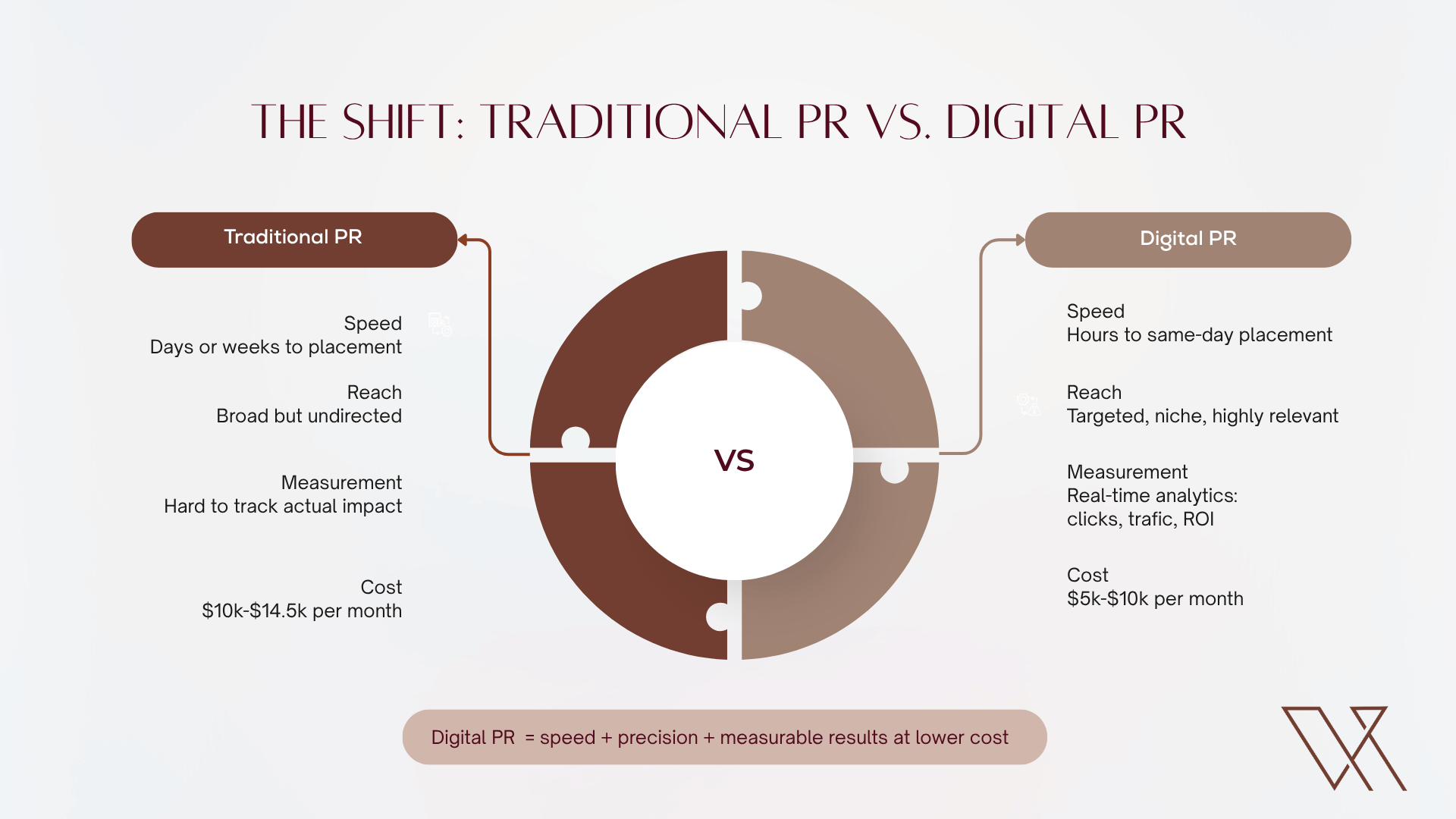
Traditional PR worked by securing placement in broadcast and print media. Though powerful, for small businesses, it could be slow and hard to measure. Press releases can take days for a journalist to read it and coverage appears weeks (or even months) later, and there was no straightforward way to track how many people actually read it.
Digital media relations work in real time. When a news story breaks that is relevant to your business, you can pitch your angle within hours, possibly landing coverage the same day. Thanks to social media, you can promote that coverage immediately. With today’s analytics tools, you’ll know exactly how many people clicked through, how long they stayed, and whether they converted.
The audience dynamic has shifted too. Traditional PR was largely a one-way street, brands talked, audiences listened. Now, digital media relations is all about a two-way conversation. Readers share your articles, comment on posts, and interact with your brand, which means your PR efforts can reach far beyond a single media placement.
Of course, successful digital PR doesn’t mean ignoring everything traditional PR taught us. It still matters to know and understand your target audience, build genuine relationships with journalists, and focus on telling stories that matter to readers, not just your brand. What has changed is the medium, the speed, and how measurable your results are.
Building Your Digital PR Strategy: Where to Start
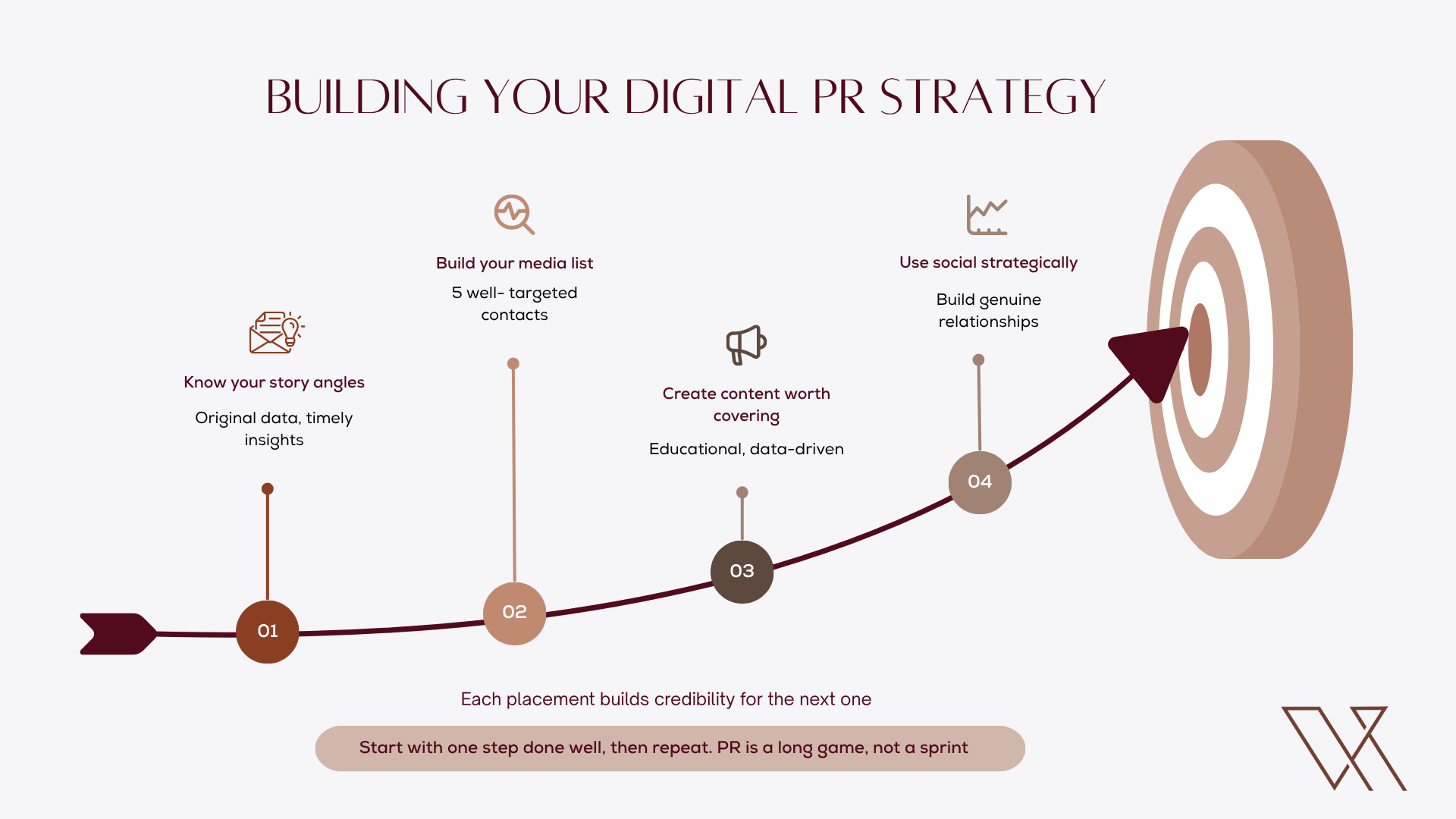
If you’re a small business owner, jumping into digital PR can feel overwhelming at first. You know you should be doing more online, but figuring out where to begin and what’s actually worth your time can be tricky. The good news? You don’t need a complicated marketing plan to set a strong foundation; you just need clarity on four key things:
1. Know Your Story Angles
Before you pitch anything to media outlets, you need to understand what makes your business genuinely newsworthy. Not every update qualifies and needs a media pitch. Consider things like a new product launch, a local milestone, a data insight from your own customers, or an informed opinion on a trending industry topic. Journalists appreciate original content—68% say they prefer pitches with original data or research (Demand Sage, 2025). If you can share something exclusive, your chances of earning coverage go up significantly.
Don’t limit yourself to traditional press releases. Opinion pieces, contributed posts, and timely reactions to breaking news can earn you placements in respected publications without the need of major announcements. Platforms like LinkedIn, Medium, and niche industry publications are all excellent options.
2. Build Your Media List
Who’s actually covering your industry? Go beyond the large outlets. Consider specialist blogs, newsletters with engaged audiences, and podcast hosts who feature business owners in your field. Research who writes about your space and what kinds of stories they usually cover. It’s worth the effort; 73% of journalists reject pitches that don’t fit their beat (BuzzStream, 2025), so doing this homework before you reach out is a must.
Start small. Five well-targeted media contacts who actually cover and care about your niche are worth more than blasting a generic email to hundreds. As you earn coverage and build relationships, your media list will grow naturally.
3. Create Content That Earns Its Place
While content strategy and digital PR are not the same thing, they’re closely connected. All the content you create, whether blog posts, data studies, infographics, or opinion pieces, can fuel your media outreach. High-quality content also helps build your brand’s authority and reputation, making journalists more likely to come to you for future stories.
For small business owners, the most sustainable approach is to create content that truly helps and informs your audience. Skip the hard sell. Educational, data-driven, and opinionated content consistently performs better when it comes to earning organic media coverage.
4. Use Social Media Platforms Strategically
Social media isn’t just a place to share your latest blog post, it’s a core part of digital media relations. Journalists and editors often pay attention to social channels in real time, and engaging thoughtfully with their content is one of the most natural ways to start building relationships even before you ever send a pitch. LinkedIn, especially, has become a go-to platform for professional visibility and thought leadership.
Over 91% of businesses now use social media for marketing (Demand Sage, 2025).The difference-makers are the brands that use these platforms to build brand awareness consistently, connect authentically with their followers, and position themselves as true experts in their space, not just those who push promotional messages.
Making Your PR Efforts More Effective: Common Mistakes to Avoid
Even with the best intentions, small businesses can run into a few common pitfalls when getting started with digital PR. Here are some frequent mistakes, and how to sidestep them:
Pitching without personalizing. Only about 3.3% of pitches ever receive a reply (Demand Sage, 2025). Why? Generic, one-size-fits-all outreach that doesn’t connect to what a journalist covers simply gets ignored. Journalists want pitches that actually match their interests and beat. Take the time to tailor and personalize your outreach email.
Expecting immediate results. Just like traditional,digital media relations is a long game, not a quick win. Building relationships with journalists takes time to build. The brands that see the biggest success stick with it, making PR an ongoing part of their marketing, not just an occasional blitz or a one-off campaign.
Neglecting the follow-up. After you send your initial pitch, don’t be afraid to follow up with a quick, polite email after five to seven days. Journalists get swamped with requests, and a polite nudge can help yours stand out from the crowd.
Forgetting to measure. 64% of brands actively track the SEO impact of their digital PR in 2025 (PRLab, 2025). Make sure you’re measuring things like backlinks, referral traffic, brand mentions, and media coverage so you know what’s working, and what isn’t.
The Role of AI and Technology in Modern Digital Media Relations
You can’t talk about digital media relations today without mentioning AI. As of 2025, 64% of PR pros are tapping-you-into AI tools to streamline their workflows (Bright Valley Marketing, 2025), and most expect that number to climb fast.
It would be difficult to write about digital media relations in 2025 without mentioning AI. 64% of PR professionals are now using AI tools to streamline their workflows (Bright Valley Marketing, 2025), and that number is only expected to grow.
Why does this matter? AI-powered monitoring can track your brand mentions across thousands of online sources in real time, flag potential reputation issues before they get out of control, and highlight trending topics that your business might want to jump on. For small businesses, this offers a real practical edge. AI can help you:
Draft sharper press releases
Find relevant journalists to pitch
Analyze media sentiment around your brand
Spot new story angles based on trending conversations
These tools can save you a ton of time, letting you focus on building relationships and telling your story. But here’s the catch: AI is a great assistant, but it’s no substitute for genuine human connection. Journalists receive hundreds of pitches every week, and 77% say that irrelevant outreach is the quickest way to get blocked (BuzzStream, 2025). No software or AI tool can replace authentic research and careful, personalized pitching that truly serves the journalist’s audience.
Measuring What Success Looks Like
One major advantage of digital media relations over the old-school PR approach is how easy it is to measure your results. There’s no need to guess whether your efforts are paying off, just keep an eye on these key metrics:
• Media coverage volume and quality. Track how many placements you earn and look at the domain authority of the outlets that feature you. Coverage in higher-authority publications carries more SEO value and more brand credibility.
• Backlinks and domain authority. Every time you’re mentioned in a media story with a link to your website, you’re earning valuable SEO points. Monitor these with tools like Ahrefs or SEMrush.
• Referral traffic. See how much website traffic is landing on your site directly from media coverage. If the numbers are good, your PR is reaching the right audience.
• Brand mentions. Track how often your brand is mentioned online, even when there isn’t a link. More mentions mean more awareness.
• Social engagement. Is your earned media making waves on social media? Track shares, comments, and likes. Media placements that spark engagement can help you reach new audiences beyond the original publication.
Your Next Media Placement Is Closer Than You Think
The approach is straightforward, even if it requires real commitment: know your story, cultivate genuine relationships with the journalists and outlets that matter in your space, create content worth talking about, and show up consistently — not just when you have big news to share.
The businesses that see the most meaningful results treat digital PR as an ongoing investment rather than a one-time event. Those steady, intentional efforts compound over time and each placement opens a door the next one walks through more easily.
If you're just getting started, don't try to do everything at once. Choose one tactic and execute it well. Pitch your expertise on a trending topic. Contribute a thoughtful byline to an industry publication. Issue a well-crafted press release around a company milestone. That first placement builds your credibility. The second one builds your momentum. And momentum, done right, builds a brand.
That level of precision requires more than a content calendar. It requires someone who understands both the craft of storytelling and the mechanics of how media — earned, owned, and digital — actually moves.
At Vérité House, we help small businesses build a digital presence that doesn't just look the part, but it commands attention, earns credibility, and converts visibility into opportunity. We bring a journalist's instinct for what resonates and a strategist's eye for where it belongs.
Because in a crowded digital landscape, the goal was never to be everywhere. It was always to be unforgettable in the right places.
Strategic. Intentional. Undeniable.
Sources and Further Reading
Muck Rack State of PR 2024 Report
Demand Sage: Digital PR Statistics 2025
BuzzStream: State of Digital PR 2025
Bright Valley Marketing: Digital PR in 2025
PRLab: 150+ PR Statistics 2025