Crisis Communication Management: How to Protect Your Business When It Matters Most

No business owner wakes up thinking, “Today, I’ll face a crisis”. But the reality is, crises do happen, and they happen more often than most people think. A 2025 report found that 44% of companies experienced at least one major brand-related crisis last year alone. Seven out of ten U.S business owners, or 70% of businesses still don’t have a formal crisis communication management plan in place.
For small business owners, the stakes are even higher. You may not have a PR team on speed dial or a legal department drafting statements. When something goes wrong (a bad review goes viral, a product fails, a social media post sparks outrage), you’re often the person who has to jump in and respond quickly. The good news? Effective crisis communication management isn’t just for large corporations. With the right plan, any business can handle a crisis with clarity, confidence, and keep long-term damage to a minimum.
This guide walks you through what crisis communication management means, the most common crisis scenarios small businesses face, and how to build a plan that protects your reputation when it matters most.
What Is Crisis Communication Management?
Crisis communication management is the process of planning, coordinating, and sharing accurate information when something happens that could harm your business’ reputation, operations, or relationships with customers. It’s not just damage control after something goes wrong, it’s also about preparing before anything goes wrong, so when the time comes, you’re not scrambling to figure out what to say.
It’s also worth noting that crisis communication is not the same as general crisis management. Crisis management is the broader operational response: fixing the problem, restoring services, managing the legal fallout. Crisis communication focuses just on the internal and external messaging throughout that process: what you tell your employees, your customers, the media, and the public, and when you tell them.
When the two work together, businesses recover much faster. But if messaging is slow or inconsistent, the reputation damage can linger long after the crisis is fixed (by months or even years).
Why Getting This Right Matters for Small Businesses
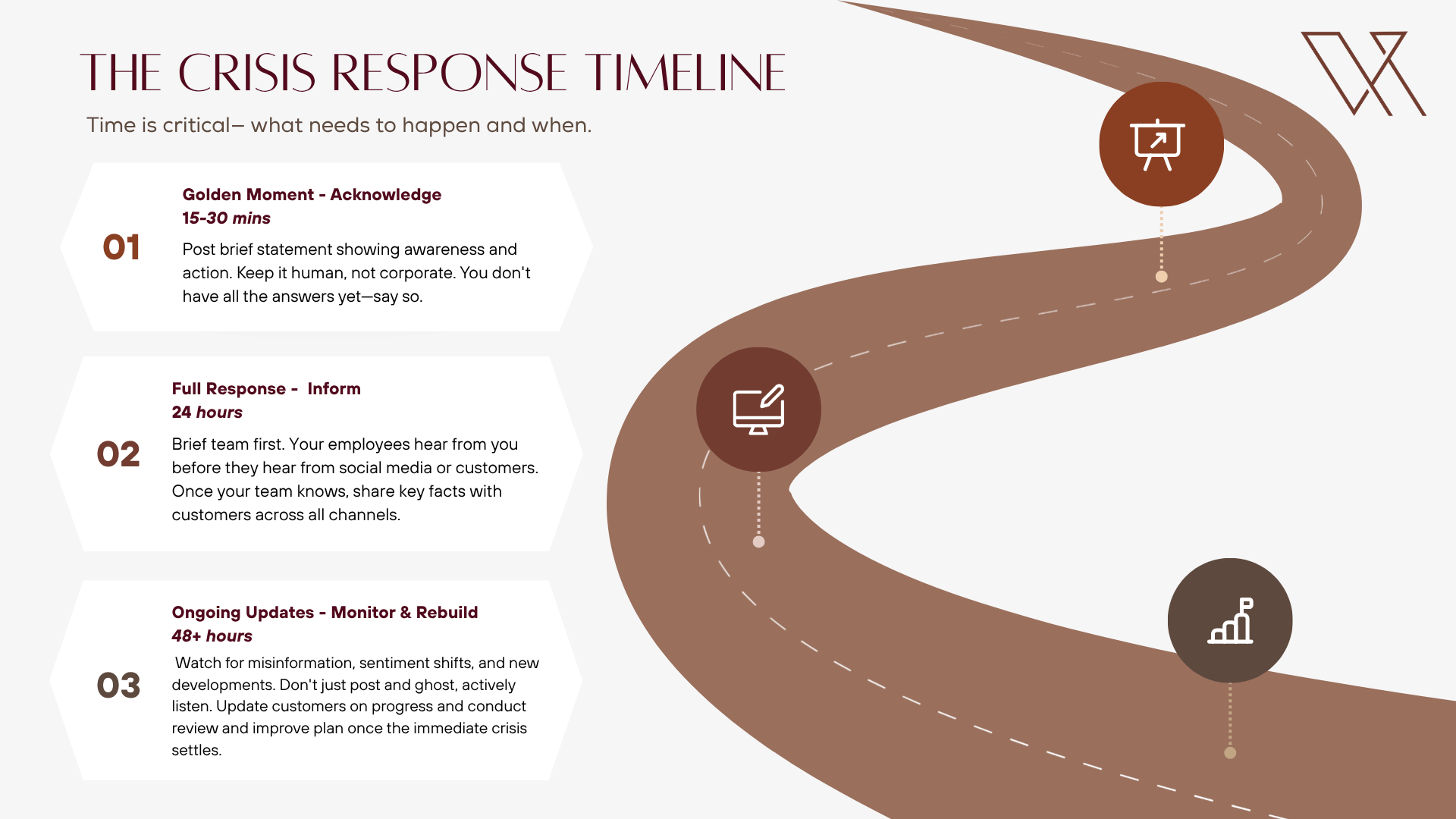
The old rule of responding to a crisis within 24 hours just doesn’t cut it anymore. As Forbes points out, you now have a razor-thin window—just 15 to 30 minutes—to get ahead of the narrative. This is often called the "Golden Moment." In these crucial first minutes, people aren’t looking for a perfectly polished statement, they just want honest, verifiable facts and a clear explanation.
If you don’t speak up quickly, someone else is likely to jump in and shape the story for you. On social media, staying silent creates room for rumors and misinformation to spread. Waiting can be risky and in fact, according to research, 41% of businesses that don’t respond within 48 hours end up with long-term reputation damage. In many cases, repairing that damage can take years…and a lot of money.
Common Crisis Scenarios Small Businesses Face
The first step in managing a crisis is understanding the risks your business could face. Not every crisis looks the same, and how you communicate depends on the exact situation. Here are some of the most common scenarios small businesses encounter:
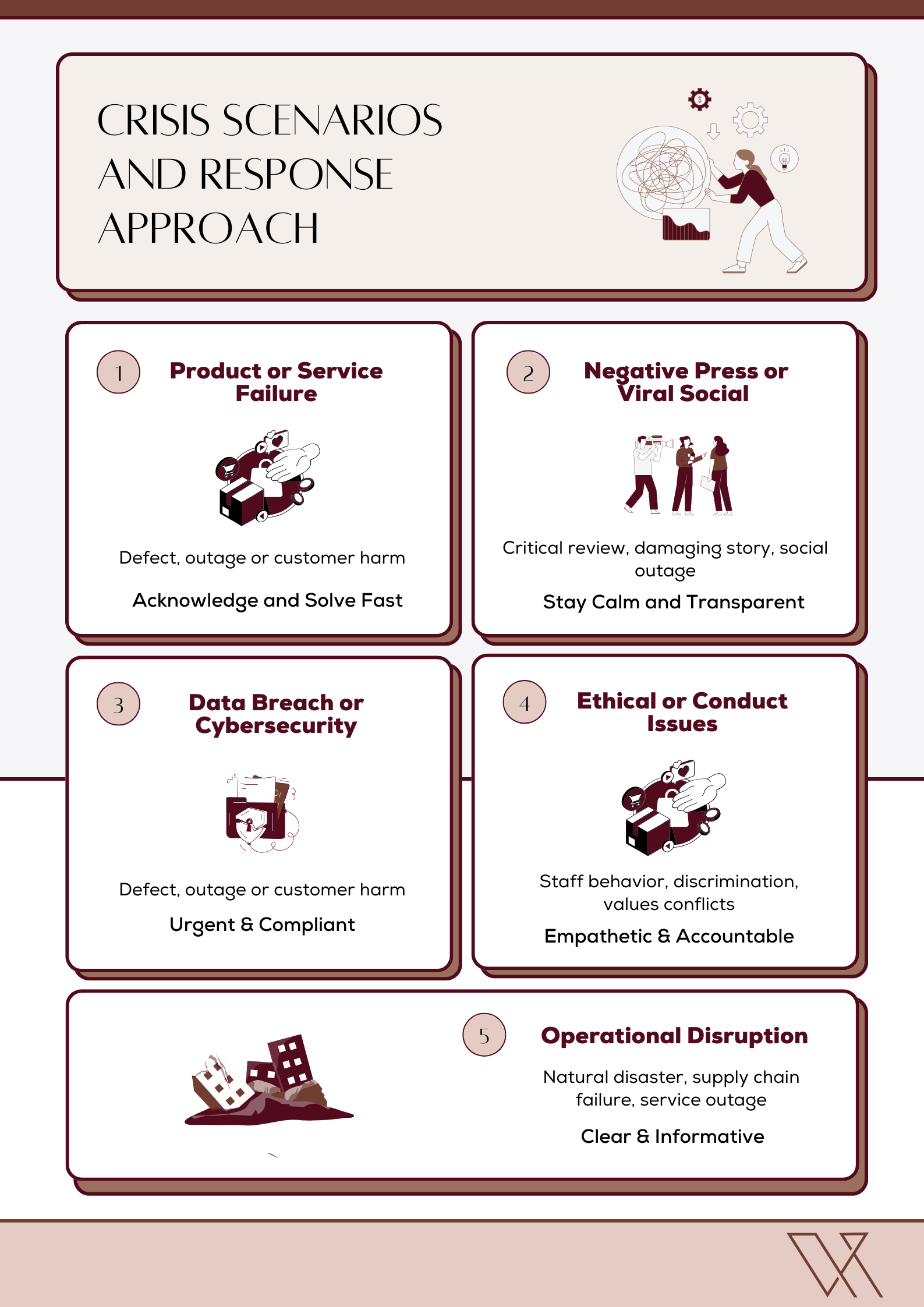
• Product or service failure: A defective product, a service outage, or a customer is harmed somehow. In these cases, it’s important to immediately acknowledge the issue, be transparent about what went wrong, and explain a clear plan for making it right.
• Negative press or viral social media: A critical review, a damaging news story, or a social post blowing up for the wrong reasons, the way you respond really matters here. Acting defensive usually makes things worse. Speed and a calm, thoughtful tone are your best tools.
• Data breach or cybersecurity incident: With 46% of data breaches now affecting businesses with fewer than 1000 employees, this issue is no longer just a concern for large companies. If your customer data is compromised, you have both a legal and moral obligation to communicate quickly and clearly.
• Ethical or conduct issues: Controversies involving staff behavior, discriminatory practices, or values-related concerns, these are especially sensitive. Approach them with empathy and accountability.
• Natural disasters or operational disruptions: Events like flooding, fires, or supply chain breakdowns can throw your business off. Your customers need to understand how they’ll be affected and what steps you’re taking to address the situation.
Whatever the crisis scenario, one thing remains true: businesses that handle them well are the ones that communicate proactively, consistently, and with genuine concern for the people involved.
How to Build an Effective Crisis Communication Plan
An effective crisis communication plan is your blueprint when things go south, removing guesswork when every minute counts. Here’s what you need to cover:
1. Form Your Crisis Response Team
Every business, regardless of size, needs a designated crisis response team, even if that’s just two or three people. Decide ahead of time who will be responsible for making decisions, who will handle internal communications, who’s in charge of social media, and most importantly, who will be the main spokesperson. Assign these roles before a crisis happens, not during one.
Your spokesperson is especially important. They’ll represent your business to the media, post public statements, and be the face of your business during tough times. Choose someone who stays calm under pressure, understands your key messages, and is comfortable speaking publicly. If that’s you, invest some time in basic media training before you actually need it.
2. Identify Potential Risks in Advance
Take an honest look at your business and map out the risks you’re most likely to face. What could actually go wrong? What would cause the most trouble? Every business is different, a bakery’s risk profile isn't the same as a tech startup’s, but every business has vulnerabilities worth thinking through in advance.
Walk through a couple of “what if” scenarios with your team. For example, what would you say if a health inspector flagged a concern? Or if a disgruntled ex-employee posted something negative online? Thinking these through ahead of time, even briefly, helps your team respond faster and with less panic if something real comes up.
3. Prepare Your Key Messages and Templates
Pre-drafting core messaging templates is one of the most practical things you can do as part of crisis management planning. Create templates for the scenarios you’re most likely to encounter: a short, honest acknowledgment that lets people know you’re aware of the situation and are taking it seriously, even before you have all the facts. Having these ready saves you precious time and keeps consistent messaging from the start.
Your templates should cover: a holding statement for public-facing channels, an internal communication to your team, a customer-facing email or social media post, and a press release if needed. These don’t need to be lengthy. Clear and human always beats something overly formal or evasive.
4. Define Your Communication Channels
During a crisis, you need to know exactly which communication channels you’ll use to reach different audiences, and who is in charge of each. Internal communications to your staff might happen via a group message or email. Customer updates might go out via social media, email, or directly on your website. Media inquiries should go straight to your spokesperson.
Don’t put all your eggs in one basket. Sometimes a platform can go down right when you need it most. Your plan should account for backup options: if your email system is down (as in a cyberattack), how do you reach your team? If your website crashes, where do you post updates? Mapping this out in advance means you won’t be scrambling to figure it out later.
Don’t Neglect Internal Communications
It’s easy to focus entirely on external messaging during a crisis, but your employees need to hear from you first. Your team will be fielding questions from customers, friends, and family, and if they don’t know what’s happening, they can’t give accurate answers. Worse, their confusion may signal a lack of control that further erodes trust.
Keep internal communications simple, honest, and timely. Tell your team what’s happening, what’s being done, and what they should say if customers ask. When your internal team is confident in your response, the public is more likely to trust it too. Based on the 2025 Edelman Trust Barometer and related 2025-2026 consumer research, consumers trust regular employees more than statements from a CEO or a corporate spokesperson. That trust translates directly into how confidently your team shows up during a crisis.
Social Media and Real-Time Crisis Response
Social media has totally changed how businesses manage crises. Information moves in real time, and silence on your channels can come across as guilt, indifference, or simply being out of touch. At the same time, reacting too quickly without all the facts can also backfire.
The best strategy? Acknowledge the situation quickly and update regularly. Even a brief post saying "We’re aware of the situation and are working on it. We’ll share more details as soon as we can" is far better than saying nothing for hours. It reassures people that you’re on top of it and that customers can trust your channels for accurate information.
During a crisis, it’s also important to monitor your social media. Keep an eye out for misinformation and correct it calmly and factually. As we’ve seen time and again, including the Astronomer CEO incident and Target’s brand identity crisis in 2o25, when a business goes quiet for 48 hours while rumor spreads online and the internet fills in the gaps, recovery becomes a much longer process. Consistent messaging across all channels is not optional; it’s essential.
Post-Crisis: Recovery and Learning
Once the immediate storm has passed, the work isn’t done. The post-crisis stage is your opportunity to rebuild trust, show you’ve followed through on your commitments, and fine-tune your plan based on what you learned.
Conduct an honest internal review. What worked in your response? Where did you lose time or struggle? Were messages consistent across all platforms? Was everyone clear about their roles? Use these answers to improve your plan moving forward.
Rebuilding your reputation over the long term means more than just surviving the storm. It means showing, through actions rather than just words, that you took the feedback seriously. Update affected customers on what changed, share the improvements you made and steps you’ve taken to prevent future issues. Brands that come through crises with stronger reputations than before are because they leaned into accountability, rather than away from it.
Crisis Communication Best Practices at a Glance
• Respond within 24 hours. Silence reads as guilt. Acknowledge early, even if you don’t have all the answers yet.
• Be honest. According to a 2025 report by Global Data Synchronization Network, 94% of consumers apparently say they’re more loyal to brands that are upfront with them, and over half claim they’ll stay loyal for life if a company is completely transparent. This just goes to show how important transparency is, especially during a crisis. So avoid evasive or vague language, and never deflect blame as consumers abandon brands that do.
• Use consistent messaging. Every spokesperson, every channel, every communication should say the same core thing.
• Show empathy first. Put people first by recognizing how the situation has affected them, before you jump in to defend your business.
• Train before you need to. Practice makes all the difference.Run through crisis scenarios periodically so your team knows exactly what to do. In fact 68% of brands increased their crisis training budgets in 2025, a trend small businesses can benefit from too.
• Review and update your plan. Crisis management planning is not a one-time exercise. Revisit your plan at least annually, and after any significant incident.
You're More Ready Than You Think
Crisis communication management isn’t about being perfect or having all the answers. It’s about being prepared and ready. When a crisis occurs, the businesses that respond well are rarely the ones that have the most resources. They’re the ones that had a plan, a spokesperson who was ready, and a commitment to honest, consistent communication from day one.
If you’re a small business owner, this level of preparation is absolutely within reach. Start with a crisis response team, map your potential risks, write a few holding statement templates, and define your communication channels. Revisit the plan once a year. That groundwork, done calmly and ahead of time or before any crisis occurs, is what allows you to protect your reputation, support your team, and keep your customers’ trust when it matters most.
Your business deserves the best protection from an experienced team. Secure your discovery call with Vérité House to understand how we provide curated support.