Examples of a Press Release: 8 Formats and What Makes Each One Land
Most press releases fail before anyone reaches the second paragraph.
Not because the writing is bad. Usually because the person writing it was never sure how to shape it, so they hedged, padded, and buried the news somewhere in paragraph three.
So let's fix that with actual examples.
Below you'll find examples of a press release for eight different situations: a product launch, an event, an award, a partnership, an acquisition, a new hire, a funding round, and a recall. Each one comes with a short model you can adapt, a note on why the structure works, and the mistake that quietly kills that format.
One thing to note–every company outlined in each sample is invented to show you structure, not to report real news.
First, the shape underneath all of them
A journalist opens their inbox on a Monday morning. There are 180 unread emails. Yours gets maybe five seconds before they decide whether to keep reading.
That's the whole reason the press release format exists. It's not tradition. It's triage.
Here's the structure journalists expect:
Headline. Eight to twelve words, present tense. Your business and the news, nothing else.
Subheadline. Optional. One line adding a second fact, not a reworded headline.
Dateline. City, region, date, at the start of your first paragraph.
Opening paragraph. The entire story in two or three sentences. Write it assuming nothing else gets read.
Body. Supporting details, the most important first. Editors cut from the bottom.
Quote. One or two. From someone with actual standing to comment.
Boilerplate. A sentence or two, or about sixty-two words about your business.
Contact block. Name, title, direct phone, email, link to your news page.
Two old conventions still hang around. FOR IMMEDIATE RELEASE at the top means there's no embargo. Three hash marks at the bottom (###) means the document has ended. Neither is required anymore. Neither does any harm.
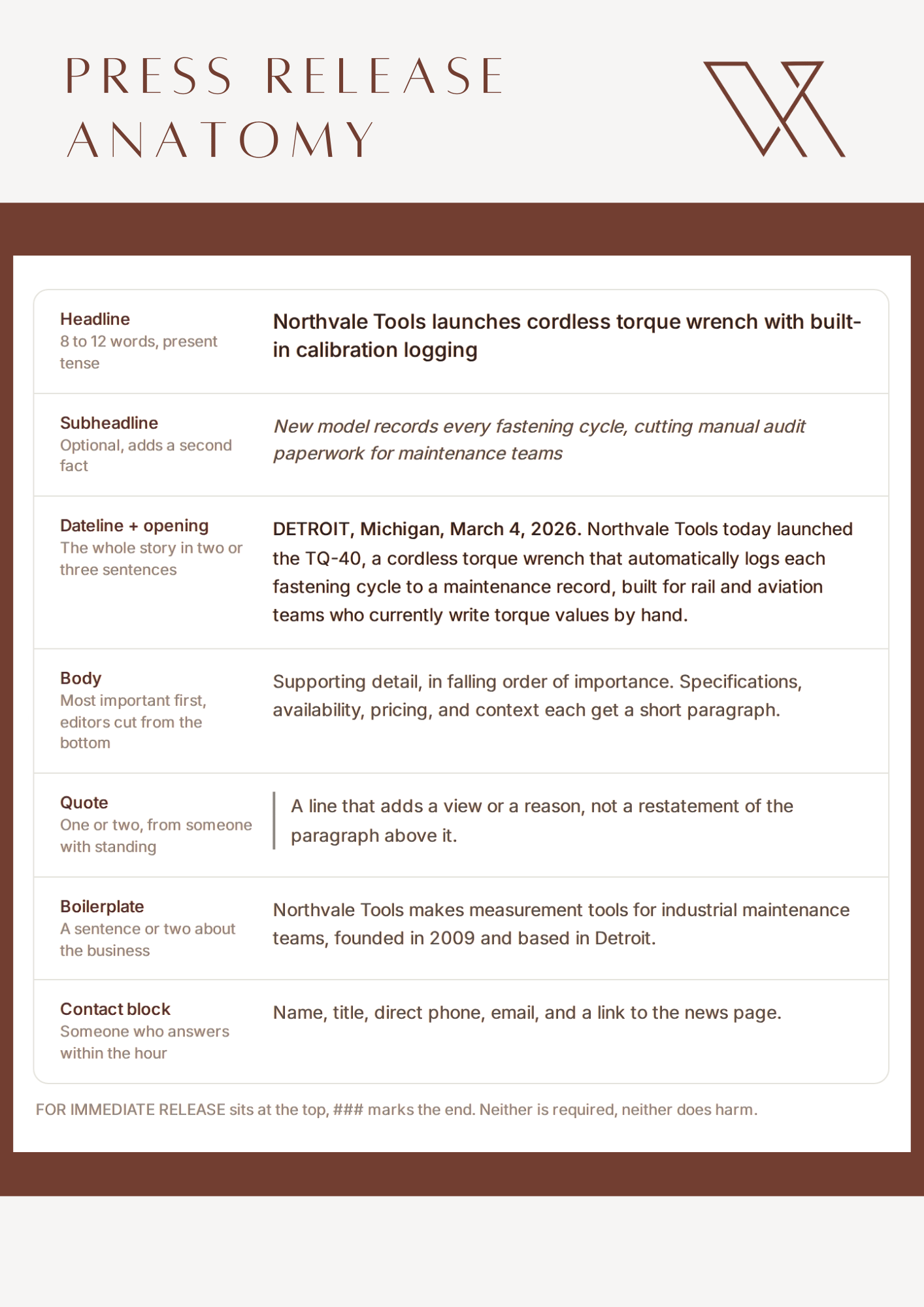
Now let's look at what this actually looks like in practice.
1. Product launch press release example
This is the format everyone reaches for first. It's also the one journalists are most tired of.
Northvale Tools Launches Cordless Torque Wrench With Built-In Calibration Logging
New model records every fastening cycle, cutting manual audit paperwork for maintenance teams
DETROIT, Michigan, March 4, 2026 — Northvale Tools today launched the TQ-40, a cordless torque wrench that automatically logs each fastening cycle to a maintenance record. The tool is built for rail and aviation maintenance teams who currently write torque values down by hand.
Why it works: the headline names a capability, not an adjective. The opening names the audience. A trade reporter knows in about four seconds whether this belongs on their desk.
Here's where most businesses go wrong. They list features and never say what changes for the customer. Try this test in your draft: could a competitor say the exact same sentence about their product? If yes, you don't have news yet. You have a spec sheet.
2. Event press release example
Event releases are the easiest to write and the easiest to ruin.
Alamo Community Food Bank to Host Free Nutrition Clinic Series Beginning April 12
SAN ANTONIO, Texas, April 29, 2026 — Alamo Community Food Bank will run six free nutrition clinics for families receiving food assistance, starting April 12 at the Westside Community Center. Registered dietitians will lead each two-hour session in English and Spanish, and childcare will be provided.
Why it works: date, location, format, access. All four in two sentences. No throat-clearing. The language note earns its place too, because it tells a reporter which audience this serves.
The mistake: burying the date under a paragraph about your organization's history. And leaving out who actually benefits from attending, which is the one detail a local editor needs before running a listing. Say who it's for. Say it early.
3. Award press release example
An award release announces recognition. The good ones tell you what that recognition was measured against.
Larkfield Logistics Named Regional Employer of the Year by the Mid-South Business Council
MEMPHIS, Tennessee, February 19, 2026 — Larkfield Logistics has been named Employer of the Year in the Mid-South Business Council's 2026 regional awards. The award is judged on staff retention, training investment and workplace safety records submitted by 140 entrants.
Why it works: naming the criteria and the size of the field turns a pat on the back into something a reader can weigh.
The mistake: announcing an award from a group that no one’s familiar with. Or, one you paid to enter. Let's be honest, journalists can spot a pay-to-play award instantly, and it costs you credibility on everything else you send. If your audience won't recognize the organization, one line explaining who they are beats another paragraph of celebration.
4. Partnership press release example
This is the part people usually overthink.
A partnership announcement only needs to answer one question, and it's the question both companies tend to dodge: what can the customer do now that they couldn't do last week?
Ridgeway Health and Bellcourt Clinics Partner to Extend Evening Physical Therapy Appointments
OAKLAND, California, January 15, 2026 — Ridgeway Health and Bellcourt Clinics have formed a partnership that will make physical therapy appointments available until 8 p.m. at four Bellcourt sites from February 3. The change adds roughly 200 appointment slots each week.
Why it works: the benefit has a number and a date attached. Both companies appear in the headline, which matters if your partner wants to run it too.
The mistake: two executives calling each other excellent partners. That's not a story. That's a LinkedIn post wearing a suit.
5. Acquisition press release example
Now this one carries more weight than people expect.
An acquisition press release lands in front of your customers, your staff, and your lenders at the same moment. Each group is scanning for something different, and each group is a little nervous.
Halden Software Acquires Meridian Analytics to Expand Reporting Capability
ATLANTA, Georgia, June 9, 2026 — Halden Software has acquired Meridian Analytics, a 40-person reporting and dashboard provider. Meridian's products will continue to operate under existing contracts, and all Meridian staff have been offered roles with Halden.
Why it works: it handles continuity immediately. Customers want to know whether their contract survives. Staff want to know whether their job does. Both answers are in sentence two.
The mistake: vague language about synergies and no word on what happens next. That doesn't earn media coverage. It fills your support inbox by lunchtime. Deal terms might be confidential. Silence about the future is a choice.
6. New hire press release example
Ashcombe Group Appoints Priya Raman as Chief Operating Officer
HOUSTON, Texas, May 6, 2026 — Ashcombe Group has appointed Priya Raman as chief operating officer, effective June 1. Raman previously led Gulf Coast operations for a national logistics firm and will oversee Ashcombe's warehouse network expansion.
Why it works: it connects the hire to something the business is trying to do. Without that link, a new appointment is internal news, and internal news doesn't travel.
The mistake: a full career history in the opening paragraph. Push it down. And attach a headshot, because trade publications will ask for one anyway and you'll lose a day going back and forth.
7. Funding or milestone press release example
Brightsill Raises Series A to Expand Its Water Monitoring Network
FRESNO, California, April 22, 2026 — Brightsill has closed a Series A funding round led by an infrastructure fund focused on rural utilities. The company will use the investment to install water quality sensors at an additional 60 small Central Valley water systems by the end of 2026.
Why it works: the money is tied to an outcome with a deadline. That's the difference between news and a nice thing that happened to you.
The mistake: leading with the number and never saying what it buys. Can't disclose the figure? Lead with the plan instead. It's usually the better story anyway.
8. Crisis or recall press release example
Wexley Foods Issues Voluntary Recall of Two Lot Codes of Refrigerated Soup
NEWARK, New Jersey, March 11, 2026 — Wexley Foods is voluntarily recalling two lot codes of its refrigerated tomato soup after routine testing identified a labeling error affecting allergen information. Customers with affected products should return them to the place of purchase for a full refund.
Why it works: what the reader must do appears in sentence two. In a crisis, instruction beats explanation every time.
The mistake: hedged wording, a slow publication date, and a lot of details hidden four paragraphs down. Announcements like this are often covered by regulation, so get legal or compliance sign-off before anything goes out.
But that's only half the story
You've got the formats. Here's the part nobody puts on these pages.
The surprising part isn't writing a press release. It's knowing whether you should write one at all.
If you've ever sent a release that nobody picked up, there's usually one reason, and it isn't your prose. The news never cleared the bar. So before you open a blank document, run these three questions.
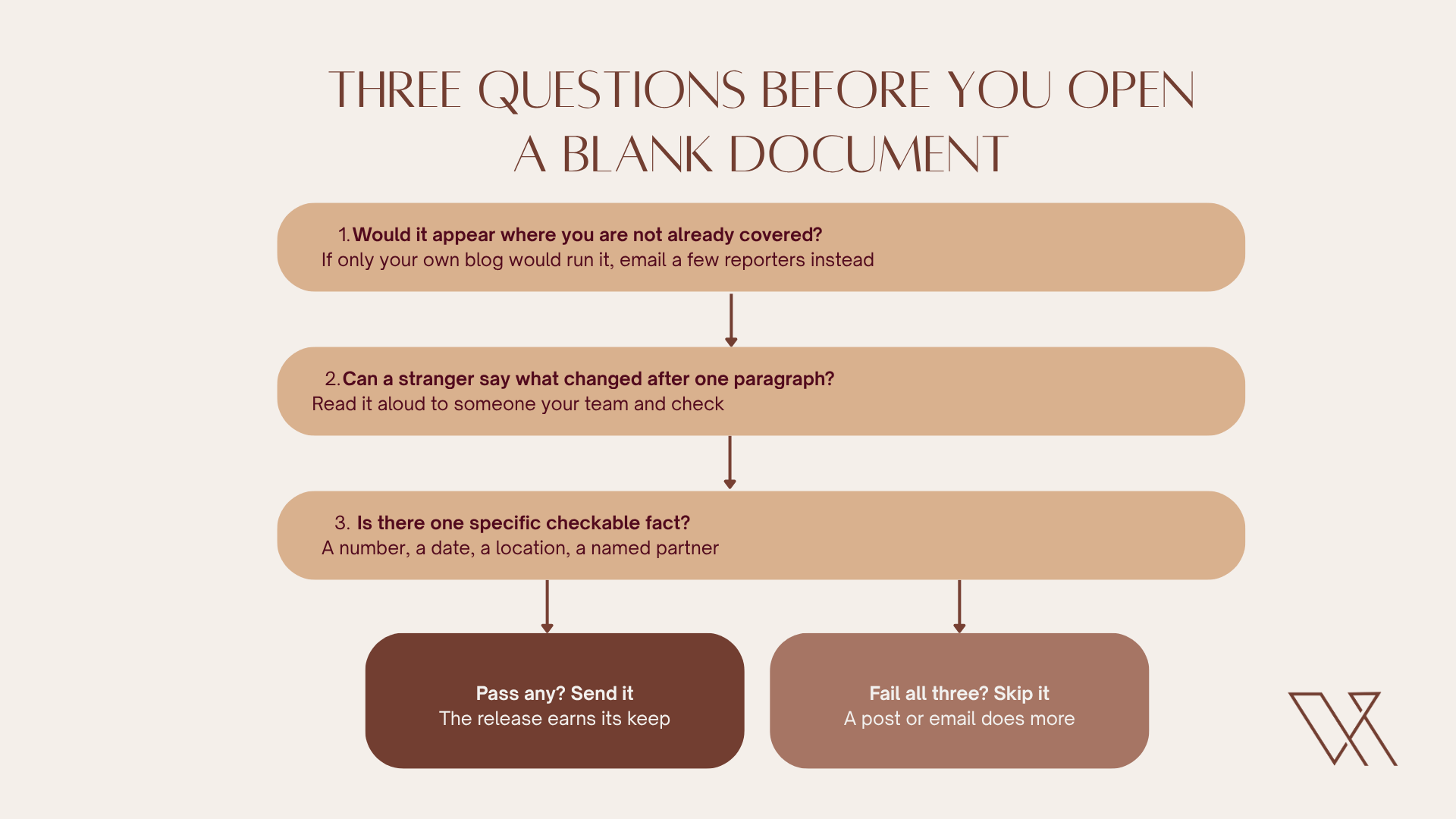
Would this appear in a publication that doesn't already cover you?
If your own blog is the only realistic home for it, publish it there and email two or three relevant journalists personally instead. Same effort. Better odds.
Can a stranger tell you what changed, and for whom, after one paragraph?
Read your opening out loud to someone outside your team. If they can't repeat it back, you're describing activity, not reporting news. This one catches more drafts than you'd think.
Is there one specific, checkable fact in there?
A number, a date, a location, a named partner. Announcements built on adjectives give a journalist nothing to verify, and verification pressure keeps climbing. Cision's 2026 State of the Media Report put accuracy and fact-checking near the top of the challenges journalists named.
Fail all three? Skip the release. A social media post or a newsletter will do more good for you.
Four things you've probably been told that aren't quite true
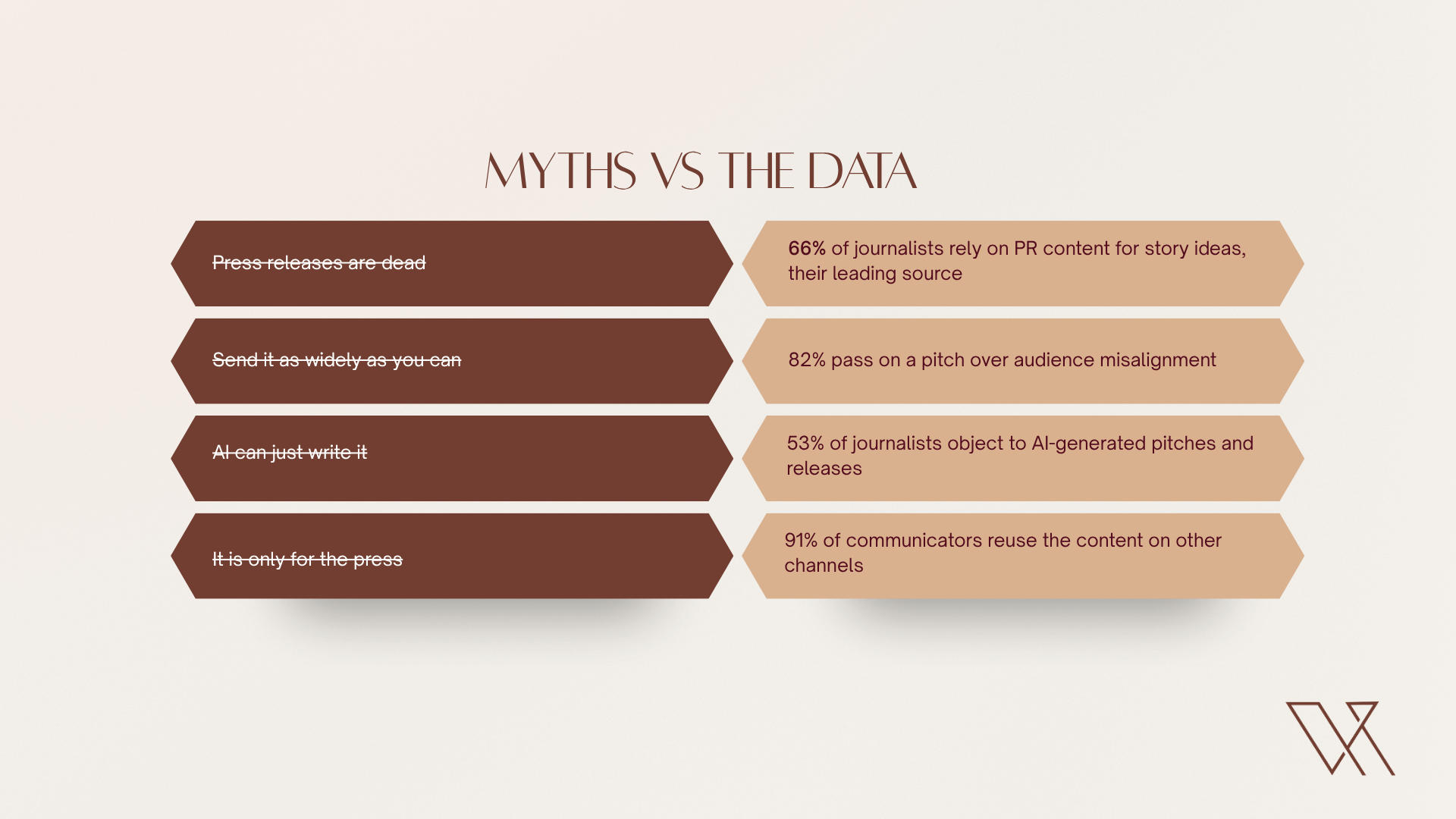
"Press releases are dead."
They're not. Cision surveyed more than 1,800 journalists for its 2026 report and found 66% rely on PR-provided content, including press releases, pitches and media kits, for story ideas. That made it their leading source of leads, ahead of social media and rival publications. What's changed isn't demand. It's how much noise your release is competing with.
"Send it as widely as you can."
The catch? Cision found 82% of journalists point to audience misalignment as a major reason they pass on a pitch. Fifteen well-chosen reporters will usually outperform a thousand-name blast, and they won't remember you as the person who wastes their time.
"AI can just write it."
Plenty of teams use it. PR Newswire's 2025 Global State of the Press Release Report found 57% of communications professionals now use generative AI for some part of press release creation, and roughly nine in ten companies include multimedia at least some of the time. But the people receiving your release feel differently. Cision found 53% of journalists object to AI-generated pitches and releases, mostly over accuracy and personalization. Use AI-powered tools for a first draft or a structure. Read every word before it leaves.
"A press release is only for the press."
Think about it. You've just written the clearest, most fact-checked description of your news that exists anywhere. PR Newswire found 91% of communicators reuse that content on other channels, most often social media. One release should give you a website post, a customer email, an internal update, and a fortnight of social content.
The checklist before you hit send
Headline under 12 words, present tense.
Opening answers who, what, where, when and why in three sentences or fewer.
Every claim has a number, a source or a named party behind it.
The quote adds a view, not a summary of the paragraph above it.
"The best" and "guaranteed" are gone unless you can prove them.
Images or video attached, with captions and alt text.
Boilerplate is current, including staff numbers and locations.
Contact details reach someone who'll answer within the hour.
Anything touching safety, recalls, finances or staff disputes has been reviewed.
So is a press release the right tool for you?
Press releases suit announcements with a fixed date, an outside audience, and a checkable fact at the centre. They're a poor fit for opinion, for something you've quietly been doing for two years, or for anything you'd struggle to defend if a reporter rang you about it.
The real trade-off is time. A targeted release plus ten personalized journalist emails takes most small teams the better part of a day. A social post takes twenty minutes. So ask whether this announcement needs someone else's credibility stapled to it. If it does, the press release still earns its keep.
There's one more reason to note if it’s worth it, and it's newer than most advice shared on this topic.
Press releases are timestamped, structured, and published on domains that AI search tools pull from. PR Newswire has described the format as a credible, timestamped record for AI engines. Which means yours keeps working long after the news cycle moves on, quietly answering questions about your business in places you'll never see. That rewards precision. Spell out your full business name on first mention. Include your location. State figures plainly. Use names where you'd normally write "it" or "they".
And watch your timing. A Friday afternoon send or the week a larger competitor announces something, will all flatten your pickup no matter how well you wrote it. If the news can wait three days, check the calendar first.
If you'd rather not do this alone
Writing a press release is rarely the hard part. Deciding whether an announcement is worth sending, and getting it to reporters who actually cover your sector, is where most of the work sits.
That's the part we handle at Verite House. Drafting, the newsworthiness press release, the media list, and the follow-up. If you have something coming up and you're not sure it makes the cut, send it over and we'll give you a straight answer either way. Talk to us about your next announcement.